



Business Culture & Wellbeing with Janine Chamberlin
Welcome to the third episode of our...
How can leaders create truly inclusive and impactful workplace?
Leadership today is about more than just making decisions – it’s about listening, learning, and fostering diverse perspectives. But what does it take to lead with authenticity and impact?
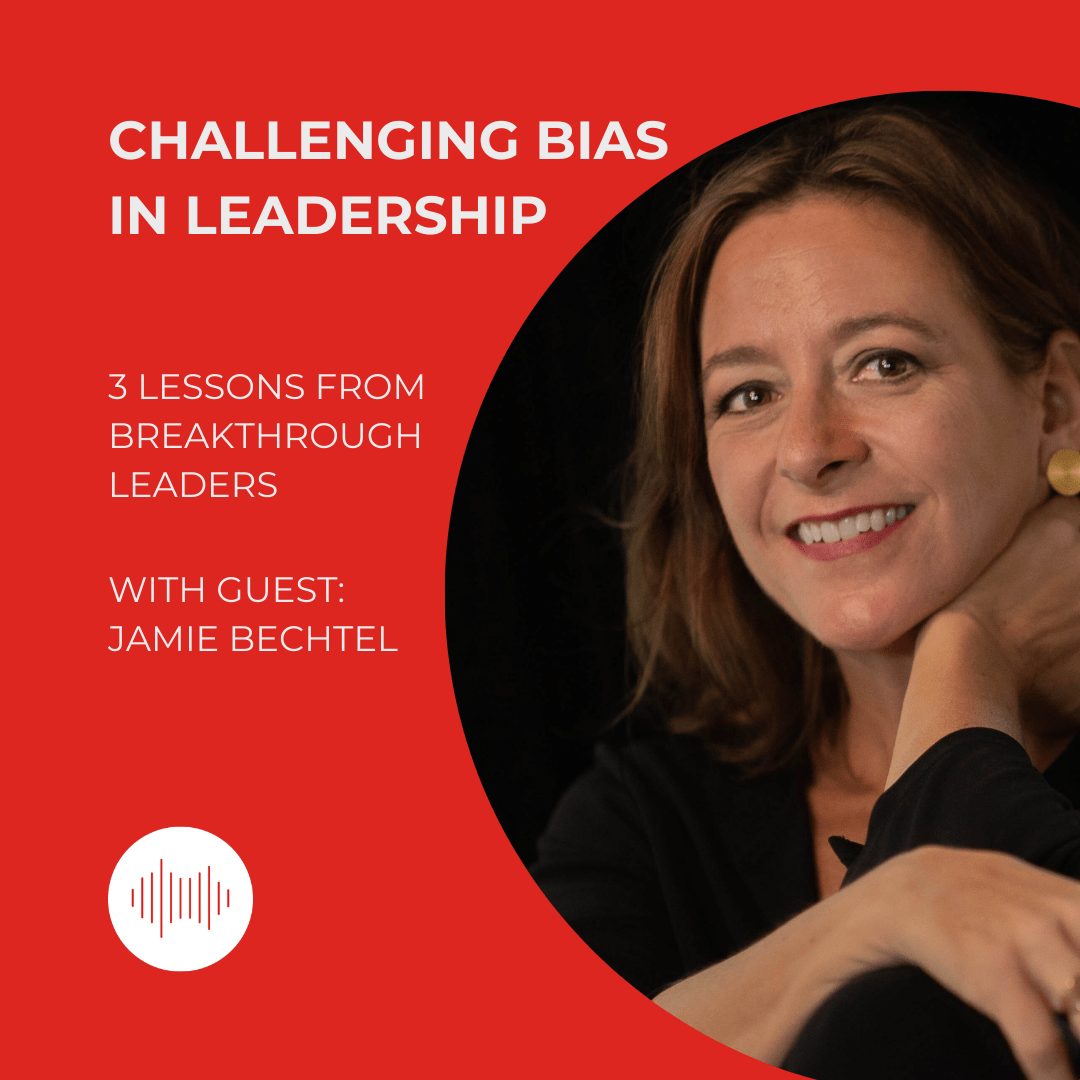
In our latest 3 Lessons from Breakthrough Leaders podcast episode, we sat down with Jamie Bechtel, founder of the Kito Impact Foundation and Yellow Card, to explore the power of listening and inclusion in leadership.
Drawing from her vast experience in marine conservation and her work with underrepresented groups, Jamie shares valuable insights on how she’s transformed communication, carved inclusive spaces, and driven meaningful change.
What Will You Learn?
Find out more about Jamie Bechtel here: https://www.linkedin.com/in/jamie-bechtel-j-d-ph-d-45315010
Lessons:
The Art of Listening
Yellow Card: Calling Out Bias in Leadership
We Need a Variety of Lived Experiences
If you like this episode, you’ll also like…
Business Culture & Wellbeing with Janine Chamberlin
Welcome to the third episode of our...
Courage & Leadership Mastery with Alexandra Dariescu
Welcome to the fourth episode of our...
Exploring Leadership & Diversity
In today’s global business landscape, leaders must...
Zannah Ryabchuk
Hi and welcome back to 3 lessons from Breakthrough Leaders with me. Zannah Ryabchuk, CEO of Breakthrough Global. I’m here again with Dr Bart Sayle.
Bart Sayle
Hello, everyone.
Zannah Ryabchuk
And this podcast is all about giving you insider tips and the know how from the world’s foremost leaders and creative talents, distilling their knowledge and experience into three lessons, which we guarantee will help you and your companies to unleash your potential. Dr Jamie Bechtel is a globally recognised conservation expert with over 25 years of experience in 35 countries. She’s the founder of the Kito impact Foundation, which helps businesses align with social and environmental responsibility. And she also leads Yellow Card, a platform for corporate culture change and Last Mile Justice, supporting environmental justice for indigenous communities. A proven innovator, Jamie has advised organisations like the UN and the Clinton Global Initiative, and has been honored by the Fast Company Magazine as one of 16 women heroes changing the world.
Bart Sayle
Hello, Jamie. It’s so good to have you here. Jamie and I go back several years. Do you want to say a little bit about how we how we met, and go from there?
Jamie Bechtel
Yeah, sure. I was a Marine conservationist, actually, at Conservation International, and you were working with Bill Wrigley. And Bill was a passionate marine conservationist, and he started engaging with Conservation International and we met through a series of conversations and projects about how to save the world’s oceans. So there are so many lessons, and I know, I’m sure we’ll get into this later, but there’s so many lessons to be learned about when you bring different people together. To bring their different perspectives and expertise. And obviously the reason we connected so recently was because of your expertise and how that shaped me and and what I’m doing now, 20 years later, right? When I was working in this space that was a very, you know, conservation remains a very male dominated space, particularly at the at the leadership levels. But I remember specifically and distinctly when I worked with Bill Wrigley and you, that I felt so heard and so welcome and so able to contribute at my best level of performance because of the way I felt in that room, that you and Bill created. With what I now understand to be a methodology, effectively. A way of being and a way of learning to be as a leader. I still have lessons learned from it all these many years later. So thank you for the experience.
Bart Sayle
Lesson One: The Art of Listening.
Bart Sayle
One of the things we say in Breakthrough is that listening is one of the most powerful skills a leader can have. But also that it’s the listening that creates the speaking. And then in terms of leadership itself, we sort of see a Ladder of Mastery. You know, it goes through knowing about leadership to talking about, a lot of people talk about leadership, and then you get into doing leadership. But doing leadership is not the top of that ladder. It’s being a leader. So it’s a state of being. And I think you put it into words because Bill had that very much about being a leader, and that’s what people feel around him so.
Jamie Bechtel
And I think what people forget is that, you know, leadership is not just the CEO. No matter where you’re at, you know, if you’re in the mail room, or if you’re in the, you know, whatever, you’re a leader. People are watching and that listening, and I see this now in all kinds of ways all over the world, is listening isn’t just about when somebody walks into your office, hearing them when they’re there. Sometimes it’s going to them. When I left Conservation International and founded a new nonprofit, co founded it with my husband actually, really centered on gender and at the time, people thought I was, lost my mind because I had quit my job at CI to do this. But I really realised that I needed to be able to articulate in my own voice what I was seeing out in the world. Without, you know, any company with any brand is going to have some constraints on it, and this was such a raw and fresh topic at the time. This is about 15 years ago, but sometimes I would be in a meeting room in Kenya or Uganda, or, you know, Fiji, and there’d be no women there, so I would go and find the women. Finding people where they’re at. There’s,, as you know, famous stories of Bill Clinton. On weekends, President Clinton would go into the offices of the West Wing and just walk around and and talk to people, right? And so listening is, is, I think, more than that, that very apparent when somebody’s there. So Bill would come to our offices. I remember the first time I sat next to him at dinner and he we talked about our kids, and it just there was this inclusivity in his approach to leadership that was very powerful.
Bart Sayle
Part of our mission statement is, is actually you start with people. You don’t start with business. You start with people. And if you want to transform a business, you need to transform the people first.
Jamie Bechtel
Yes, you know, I used to tell the story, if you go into a village and a woman has never been allowed in the meeting space, and she’s never been asked what her opinion. And you ask her what she thinks, she’s got some stuff to say. She’s got years of having been in the thick of it. She’s got all of the solutions. And people will sort of ask me, ‘How do you know when to stop listening?’ And it’s very simple. At some point, whoever you’re listening to is going to turn to you and say, ‘What do you think?’ and that’s your cue, right? So that’s my challenge to myself. Is wait for the, ‘What do you think? ‘ or, ‘Did that make sense?’ Or, you know that cue, that, ‘Ah, thank you for listening.’ Yeah. part of my background is in anthropology, and I can remember something that really touched me and is still with me. I was working out in in Nigeria, and I remember interviewing this, this man who was about, probably in his 60s. He was a gardener. I was interviewing them about, of all things, It was a commercial. I was working for Unilever at the time, but we wanted to understand what their personal grooming behaviour and habits were to sell more products, of course. But anyway, I was enjoying the anthropology side of it. And I remember asking him, you know, for a conversation, and I was asking him this. And really at the end of the conversation, there were tears in his eyes, and he grabbed hold of my hand with both hands. And he said, ‘Thank you, sir.’ He said, ‘Nobody has ever asked my opinion before.’ Incredible. So powerful
Bart Sayle
Yeah.
Jamie Bechtel
Well, and the other thing that happens is when you come in with an agenda, you ask a certain series of questions. That’s expected, right? So I was working with a client. I was in the Galapagos a couple years ago, and there was a farm, and the sort of regular, usual question and answer session happened. My client, who had been there for a period of time, a long period of time, they were done with their questions. So I sort of said, ‘What role does your wife have on the farm?’ And he said, ‘Well, mostly it’s women who go to the farmer training, but we have two children with learning disabilities, and she is a full time caretaker for the children. So my follow up question was, two children with learning disabilities. Are there a lot of children with learning disabilities in the village? And he said, ‘Yes.’ And I said, ‘Is it from pesticide use?’ And he said, ‘No, it’s from the water.’ In years and years of working in this community, it was a simple fix. A relatively simple fix, but the question had never been asked.
Bart Sayle
So the, what’s that phrase? The answer is in the question. So,
Jamie Bechtel
Yes.
Bart Sayle
Yeah.
Jamie Bechtel
Yeah and it’s ubiquitous. You can, you know. If you’re teaching soccer, your kids soccer team, or you’re, you know, in the boardroom. Those questions make all the difference.
Bart Sayle
As Jamie said, listening is such an important foundational skill for leaders. And in Breakthrough, we take this very seriously. The quality of your communication is more to do with the way you listen. Our aim in Breakthrough is to help people transform their listening so. And the way that’s done is to distinguish that we’re already listening to ourselves and our inner voice before we start listening to anyone else. And it’s learning how to control and manage the inner voice that helps you to listen better, listen fully, and listen in a very different way. Yeah,
Zannah Ryabchuk
So ask yourself, as a leader, are you putting the majority of your emphasis when it comes to communication on how you listen and how you listen powerfully to the other person that you’re in a conversation with, or are you actually putting most of your emphasis on how you’re going to speak next? Are you one of those people that’s almost waiting for the chance for the other person to stop so that you can speak again? Because if that’s the case, you’re not managing your inner voice. You’re not learning how to dial that down and dial it up appropriately.
Bart Sayle
Lesson Two: Yellow Card. Calling Out Bias in Leadership.
Bart Sayle
So Jamie, one of the things you mentioned earlier, which has intrigued me is Yellow Card. So can you tell us more about that?
Jamie Bechtel
So Yellow Card is a project that I’m just getting ready to launch. Let me back up just a little bit. You know, I turned 52, years ago. So the week that I turned 50, I was in a meeting with a Silicon Valley investor and some Stanford folk, and the Silicon Valley investor said, ‘Jamie, you be quiet while I introduce you.’ Apparently this was kind of funny. And so the other guy said to the other woman on the call, ‘You be quiet while I introduce you.’ And so the next day, the investor called to ask me how I thought the call went. And I said, ‘Well, besides the fact that the two women on the call were actively silenced,’ and his response was, ‘Well, I just know you have such a good sense of humor, and I was just being funny.’
Bart Sayle
Well, that’s classic passive aggression. I mean passive aggressive comment, and when it’s called, they’ll say ‘I was joking.’
Jamie Bechtel
And right? Thank you. That the idea that my bad sense of humor is an excuse for your terrible joke just really caught me, you know, rubbed me the wrong way. So I provide that context to say Yellow Card was born of this frustration. And Yellow Card is really this concept of we can all go to leadership training and some leadership trainings are better than others, you know, but those teachable moments are escaping so many of us. And it doesn’t have to be highly confrontational. It just, we need a tool that sort of says, ‘Hey, not cool.’ Yellow Card itself is a tool to call out those microaggressions in the workplace, and I have learned to use Yellow Card. I have been yellow carded for things, you know. I asked somebody about a spirit animal, and I was like, ‘What’s your spirit animal?’ And and in a meeting, and a young woman, she knew about yellow, she said, ‘Jamie, that’s a Yellow Card. That is the misappropriation of very sacred religions,’ and she was right. And it wasn’t a drama. And I know not to do that now, and I’m a better leader for it. And so Yellow Card is this specific tool. And you know, one of the important parts of leadership is continuing to hone our skills. Right? Surgeons don’t stop practicing doing surgery. Police officers don’t stop brushing up on the law, right? So as leaders, we have an obligation, especially as we’re leading younger generations or people from different cultures, to continue to hone our craft. And so Yellow card is this sort of bringing together of those tools that enable a space where people feel like they can deliver their best. Which has a great bottom line for a company.
Bart Sayle
So this is great. Where do you want Yellow Card to go?
Jamie Bechtel
The impact that I want Yellow Card to have is that every woman has the tools she needs to advocate for herself in the workplace. And every woman in a position of leadership with, you know, every woman with agency and every guy have the tools that they need to advocate and help to create space. And interestingly, there have been a few women, but it has been men who have helped to create space for me. So when I joined the board that I’m on now, it was a man who, I didn’t know anything about being on boards at the time. I was being quiet and listening, and one of the guys on the board said, ‘Jamie, I’d like to hear your thoughts on this,’ and actively created that space. And now I’m chair of the board, because those thoughts led to change in the company, and that was a great experience. So men have a very, very important role, and there are a lot of men, almost the same number of men who see the patterns of microaggression and they just don’t know what to do about it. And so on our podcast, for example, we always ask the women that we have on to bring a male ally on. And it’s a conversation. One of the things that does is help to remove othering. This is not just a space for women. This is a leadership space. And leadership, you know, if you look at the studies and the book Yellow Card, and a lot of our content is quite scientific, actually. So there’s, we look at studies. There are fantastic studies about the Supreme Court, and they’ve analysed the recordings and the number of interruptions that are done by the men on the Supreme Court toward the women right where, if you there’s been analysis of shareholder meetings, and men occupy 98% of the airwaves in those meetings. So we know that men are still, occupy most of the traditional leadership spaces, and we know that there’s a leadership crisis. So what we’re doing is not working. So this is an alternative way to pursue change, which includes capturing those teachable moments and aggregating information for all parties. You know, this is a subtle way to hopefully change that workspace.
Zannah Ryabchuk
So the reason that we love the Yellow Card concept is because it’s simple. And from all of the experience that we have at Breakthrough, we know that simple tools are the best tools. Often what can happen when there’s a difficult conversation or something where people are not sure they don’t want to put their foot in it, they don’t want to say the wrong thing, we can really overcomplicate the way that we approach it, and it ends up with actually people saying nothing at all. So by having theYellow Card, it’s fun, it’s light hearted. You can use it with your friends, you can use it with your family. You can use it with a colleague. But you know that it’s got a deep meaning and the profound meaning behind it that will enact a change of response, that will enact a difference of behaviour in the future. So we’d encourage people to start using it. It’s really easy to use, and it will have an impact.
Bart Sayle
Lesson Three: We Need a Variety of Lived Experiences.
Bart Sayle
In our conversations, leading to the podcast and getting to know each other again. What I’ve been impressed about is that in your conservation era, you and places like Conservation International, one of the things that they were attempting to do is bringing business to conservation. But what you’ve done now is you’ve sort of reversed that process, and you’re now taking some of those principles of, it’s beyond conservation what you talk about, it’s really humanity and taking those now back into the business world.
Jamie Bechtel
That’s exactly what I’ve been doing. And I had a few years of, I might almost say insecurity around it, because, again, I’m trained, you know, I have a PhD in marine ecology, and I have a law degree in international law, which is more traditional, I guess, you might say, but I had this very bizarre experience where I worked with some of the biggest business people in the world, you know, all the way down to I would go sailing fishermen or spend the night cooking with women and huts. So I had this array. And what I started noticing is I would, I would be brought on the panels to translate between the top down and the bottom up, and to really, you know, turn to this person say, let me give you an example of what this looks like on the ground. I didn’t realise how transferable the skill set was. And that’s because the skill set was this very diverse education of talking to so many people and listening to so many people and bringing that very holistically to bear and in leadership. And then pivoting and sort of saying, wait a minute, this is actually no matter where you walk. I was just in the prime minister of Fiji’s office, for example, and I was saying to him, he built Fiji Air, and I’m terrified of flying. And you know, I said to him, ‘Look, I am an authority on alcohol on airplanes, because I drink an every flight I’m on,’ and we had a great laugh over it, right? And so right away, you’re connecting on a human level. And that’s really what leadership is. Is that, is finding those points of connection. And finding, you know, recognising that we are all equal players.
Bart Sayle
Yeah.
Jamie Bechtel
One of my biggest pet peeves, and I write about this in Yellow Card, women are often defined as rising stars. ‘Oh, she’s a rising star.’ You never hear men defined as rising stars. In fact, I remember there was one day I was at CI and I was kind of mad, and I was like, ‘I am a breaking star. Right now. I will be a brighter star someday. I will be a dimmer star someday, but I’m a star.’ So I, when women say, like, ‘I’m kind of a rising star in this,’ I shut them down right away, and I say, ‘You’re a star. Don’t let anybody tell you you’re not, and you’re gonna be more influential, and you’re gonna be less influential, but you’re not rising. You’re a star.’ So anyhow, that, yeah, making sure that we understand that everybody, we’re all human, we all have this great equaliser, and then you’re able to meet people and understand they’re part of your solution. They’re part of what you need to do. So that, I think that ethos of there’s benefit to talking to everyone. There is there’s solutions in talking to everyone. There is joy, frankly, in talking to everyone. I’ve never met a person who doesn’t have a great story.
Bart Sayle
In our briefing call, I was very taken with your views on diversity in leadership, but particularly about diverse thinking, because it’s not just about gender, it’s not just about race, and that chimes with my feelings about diversity in its most holistic sense,
Jamie Bechtel
I think an interesting way to think about diversity in part, because everybody you know, there’s a lot of baggage around the word diversity. But the goal is really to, it’s twofold. One is to eliminate othering, right?
Bart Sayle
So inclusion, yeah?
Jamie Bechtel
It’s inclusion, but it’s, you know, othering is a natural instinct. It’s innate to us. We feel safer when, when we’re with people that are like us. And so what happens fast forward to diverse thinking is if we’re all similar and we’re all saying the same thing, because that’s what’s safe, we’re not getting the business solutions that we want. We’re getting yes people, we’re getting very sophisticated, very smart, yes people who are very good at making it sound like they’re not yes people, right? Because none of us are yes people. We all have our fight in us. But that’s effectively what’s happening. And so that’s stymies growth. It’s stymies production, and it’s stymies then the ability of a business to be as its most successful entity. And so diversity does not have to necessarily mean like, well, two things. One, just because you have a diverse room doesn’t mean you have diversity of thought, and just because you have a room that looks similar to each other physically does not mean you don’t have diversity of thought. It’s really about those those backgrounds. It’s really about the training that somebody has had. It’s really about, and I say this to young people. I’ve just started changing my advice dramatically for young people with the, you know, the inbound of AI and the hereness of AI. The only thing 2030, years from now that is going to be valued is that personal journey and what you as an individual can contribute, because that coherence of thought, that singularity of thought, will be wiped out by AI. It’s already happening, but your individual journey, the questions that you learn to ask along the way, the personal experiences that you have that distinguish you from all others, that is the only thing that will be valued in the very near future. And so learning to find that diversity of thought., utilise that diversity of thought, if you’re not a leader that’s good at that, you’re not going to be a leader in the near future.
Bart Sayle
What impressed me about Jamie, and why I was so excited to have her on our podcast is that her journey. She’s had many, many different experiences and many, many different lived experiences, and she now sees that as key to creating a diverse team, or diversity within a team. Often, diversity is seen in a one dimensional or couple dimensional way. But when you start to think about the diversity of thought and the diversity of experience that people can bring and use as a resource within the team, then you get something much more powerful.
Zannah Ryabchuk
But as human beings, we really love being comfortable. And so we tend to congregate towards people who are similar to us, have similar interests to us, have similar lived experiences to us, and this stops us growing. It stops our horizons from shifting. So ask yourself, Am I in my comfort zone at the moment? Do I have conversations with people that seem to agree with me all the time? And if that’s the case, how can I expand that network? How can I expand the conversations that I’m having, so that I’m making sure I have that exposure to people with very different lived experiences to my own. In order to come up with the best solutions, to solve problems, in order to come up with the best strategies for the organisation, and to make sure that you haven’t missed something. To make sure that there aren’t blind spots there from being in An echo chamber.
Bart Sayle
Another point is that, as a leader, are you going far enough to encourage people in your team to share some of their lived experiences that that they haven’t shared up to now? Have you built enough psychological safety within your team that people are willing to do that? Because then there’s more resources for you as a team. So Jamie, we’re going to come on to your hot seat questions. What inspires you in life?
Jamie Bechtel
You know, it is such a magical, complex, interesting, I’m gonna cry. It is such a beautiful world. People are wondrous. Nature is absolutely brilliant and fascinating and what else do you need to get out of bed in the morning? I mean, it’s just a magical place to spin around the universe in.
Bart Sayle
That’s brilliant. Brilliant. What brings you energy and motivation in your everyday life?
Jamie Bechtel
I joke, I get asked a lot what keeps me going on some of these difficult topics that I work on. Human trafficking, environmental loss, all these things. And I always joke that, you know, we know how it ends. In 4 billion years, the sun blows up. And so every day is worth its own weight, right? Whatever we do in a day that is its inherent value is that day, and all we can do is is get up and have the best day we possibly can. Fight the best fight we possibly can. Make the biggest impact we possibly can. Make the most people feel welcome in your space. And so instead of worrying about that big, heavy, you know, state of play. Waking up today and that and a good cup of coffee.
Bart Sayle
Now, is the desert island question. What’s the one book that you would take?
Jamie Bechtel
You know, interestingly, and I got a lot of flack from my husband for a long time on this. Atlas Shrugged.
Bart Sayle
Ooh.
Jamie Bechtel
Yeah. And he was very horrified at one point to know that that was one of, if not my favorite books. And so I told him he was not allowed to comment on it until he had read it in its entirety. And, you know, politically, obviously, both sides of the aisle take and run with that with strike. But what I love about it is it kind of comes back to my last answer, is showing up to be wherever you at. Whether you’re a mom for the day, or you’re in charge of the dog for the day, or you’re at work for the day, or you’re, you know, driving the kids to the camping thip. Being the best in that day that you can possibly be. Just just showing up and excelling in that moment, I think is the root of, take away all of the nonsense about capitalism and all of that. The book is fundamentally about bringing your best self to every moment that you can and I find that to be quite inspirational.
Bart Sayle
Fantastic. Jamie, you’re a star.
Jamie Bechtel
Thanks Bart. Bart, you are also a star.
Bart Sayle
Thank you. But look, thanks so much, Jamie, I’ve thoroughly enjoyed this. If it was just the conversation, but it’s going to be a brilliant podcast.
Jamie Bechtel
Thank you for the opportunity.
Bart Sayle
Yeah.
Zannah Ryabchuk
So thanks again for joining us. Remember to hit. the subscribe button and join us again for our next set of lessons. And if you’ve got any questions or comments, email us atbartsayle@breakthroughglobal.com or connect with us directly on LinkedIn at Breakthrough Global.
Bart Sayle
We’d love to hear your own leadership stories, and we’d also love for you to share this episode on your own social media and review and rate this podcast on your player of choice.
Zannah Ryabchuk
Thanks to our production team, Julia Soltysova at Breakthrough Global and Robin LeeBurn at Fairly Media. And of course, thank you for listening.
Listen to our latest podcast episode with Steve Challouma! In this conversation, we focus on brand stewardship...
Listen to our new podcast episode where we explore the power of playbook culture from accomplished CEO...

Listen to our new podcast episode where we explore how Wrigley’s cultural transformation took them from a...