



A Journey to Conscious Leadership with Edgar Huber
In our latest 3 Lessons from Breakthrough...
In our latest 3 Lessons from Breakthrough Leaders podcast episode, we’re joined by Norberto Chaclin, EVP and Chief R&D Officer at Mondelēz International, leading global innovation for iconic brands like Oreo, Ritz, Cadbury, Milka and Toblerone.
Norberto has held key R&D leadership roles across the company, driving major product innovation. Before Mondelēz, he spent 18 years at PepsiCo in senior positions across Frito-Lay, global beverages and joint ventures, ultimately heading R&D for PepsiCo North America Beverages and the Pepsi/Starbucks partnership.
In this episode, we explored 3 lessons with Norberto:
1. Lean into new experiences
2. Lead Innovation for Innovation
3. Without a Vision, you’ll be left behind
This podcast brings you genuine, inspiring conversations with extraordinary leaders, many of them Breakthrough alumni, who are proving that business can be a force for good. Created with purpose, not profit, it’s designed to spark fresh insights and help leaders at all stages make an impact.
Find out more about Norberto here: https://www.linkedin.com/in/norberto-chaclin-613840
Lessons:
Lean into new experiences
Lead Innovation for Innovation
Without a Vision, you’ll be left behind
If you like this episode, you’ll also like…
A Journey to Conscious Leadership with Edgar Huber
In our latest 3 Lessons from Breakthrough...
Courage & Leadership Mastery with Alexandra Dariescu
Welcome to the fourth episode of our...
Holistic Leadership with Sylvie Moreau
Most leaders lead from the Head. Some...
Hi and welcome back to 3 Lessons from Breakthrough Leaders with me, Zannah Ryabchuk, CEO of Breakthrough Global, and I’m here again with Dr Bart Sayle.
Hello, everyone.
And this podcast is all about giving you insider tips and the know-how from the world’s foremost leaders and creative talents, distilling their knowledge and experience into three lessons, which we guarantee will help you and your companies to unleash your potential.
Today, we are joined by Norberto Chaclin. Norberto is EVP and Chief R&D officer at Mondelēz International, leading global innovation for iconic brands like Oreo, Ritz Cadbury, Milka and Toblerone. He’s held key R&D leadership roles across the company, driving major product innovation. Before Mondelēz, He spent 18 years at PepsiCo, in senior positions across Frito Lay Global Beverages and joint ventures, ultimately heading R&D for PepsiCo North America beverages and The Pepsi Starbucks partnership.
Lesson One: Lean Into New Experiences.
Norberto, look we are absolutely thrilled to welcome you to the Breakthrough podcast today. So we’ve had the pleasure of working together before we worked together with your R&D team at Mondelēz, and Bart is meeting you today for the first time. So a big welcome from us. Thank you so much for being on the podcast.
It’s great to meet you.
Likewise, thanks for having me.
So the kind of prompt that got me to reach out to you about this was really some other podcast material that I’d seen where you were talking about AI and leadership and some other pieces. I’d love to kickstart with a little bit, maybe going back from there, and a little bit about your career and where you’ve come from to get to where you are today. Would you mind sharing some of that with us?
Yeah, of course. I would say my career is a combination of steps that I probably didn’t plan at all. You know, I studied chemical engineering with the intent of being in oil and gas because that’s what my father did. Didn’t like it much, and never went into that industry. So it was really by lack of something else that I ended up with an internship at Pepsi and Frito Lay in the US. You know it was you had to do something. So that’s the those are the people that gave me an internship. So I took it with zero expectations about that industry at all. Actually knew nothing about it, to be honest, but it was, it was an eye opening experience. You know, you can apply your skill sets to things that people actually buy and consume, as opposed to working on chemicals and other manufacturer things that that consumers actually don’t really know what they are. It was a lot more fun to work in a consumer products industry. So that was completely eye opening to me. Not at all something I expected, but that’s how it started.
I was always on a mission to get an MBA, so I thought it would be a temporary gig at Pepsi until I quit and get my MBA. I ended up doing the MBA part time for various reasons, financial and others, with every intention of being in finance and banking. But as I was doing the MBA, I realised all the case studies were about the sorts of things that I worked on. We did case studies on Doritos and other consumer products. I was like, I actually work in this industry that all of these business case studies are about. I’m lucky that I get to work and study the same thing. So sort of an appreciation or love for the category and the business and the industry formed. By the time I finished the MBA, I never went into banking and finance. I actually went into strategy within, within Pepsi, and worked on strategy, R&D, product innovation got more into the front end of Innovation over time, and that’s what I’ve done ever since.
I was speaking with a multi time kind of client of ours. And he was talking, I was talking to about inspirational leadership, actually. And I was saying, when have been the times when you’ve worked in organisations and transformations have really they’ve really worked. He said, Well, it was when I had an inspirational leader. It was beginning of my career at Pepsi, and I had a leader who just let me fail. You know, I knew I was never going to get, his word was bollocked, but I knew I was never going to get in trouble if things went wrong. And I was just trusted and empowered, and I was coached and nurtured, and so we just achieved incredible things. And I hear a lot of stuff like that, actually, from from Pepsi, from a few years ago. So it’s interesting, that was the start of your journey.
It’s a bold culture, if you will. Like, there is a bit of risk taking, which was fun. I didn’t know any different, to be honest. I spent the first, you know, significant part of my career there. So you don’t know any different. It’s a tough environment, but if you compare it to others, it allowed you to experiment quite a bit. We’ve done some great, I did some crazy things, and I had the money and the budget and the time to think and do them. So which was quite, quite exciting.
Norberto, could you tell us a little bit about the mentors you’ve had over your career, or people that have really shaped who you are now?
Yeah, the one thing I can say is I’ve often been assigned mentors, and I never found that that really worked. I couldn’t even tell you who those were anymore. It’s when I self identified mentors is when they worked better. I would say the most significant one was probably my father, who was a businessman himself, was my motivation to study engineering, even though I went to do something completely different. He never understood why I went into the food industry. He never understood what I did and why that was technically so difficult. He was a oil and gas person, but he still had advice and really simple advice. Usually, his advice was very, very simple. It was never, never complex concepts. It was, you know, change is always here, and it’s good. Don’t go against the grain of change, because you’ll just be left behind, just stuff like that. He always had very simple ways of saying, You’re overthinking this. You know, you’re just a young guy in a big company, get on with it. These people know what they’re doing. You know, learn, learn, and then you’ll see one day you’ll get to make these decisions or things like, the higher up you get, the more lonely it is. But don’t worry about it. You know, you’re not going to keep everybody as a friend. If you’re a good leader, everybody isn’t going to be your friend. There comes times when you have to make difficult decisions, and some people won’t like that. And you know what? Either you want to be a leader or you don’t want to be a leader, but if you’re not able to make tough decisions, you’re not going to be a leader. That sort of stuff came from him. So that that was probably the, the primary one.
Then I would say I have many mentors that were junior to me. I found, actually the more interesting mentors are usually people on my team, or not even on my team, that were not at the same seniority, but they had good insight in in the business, or they asked good questions, or sometimes they were people that asked me to be a mentor. And I found that the relationship was was mutual, and I got as much out of it as they did. So I think being humble, that the mentor doesn’t have to be the CEO or the senior vice president. A mentor could be someone from a totally different place, but they just have a good insight, and they have a good, good way to look at you and say, Huh, I think this might be the way you should think about it. And I’ve found, often people that are not in my exact world to be much more effective mentors. They could be friends who, frankly, probably I would never work with. They’re totally different and not at all, of the same mindset or technical education that I am, so I probably would never be with them in a work environment. But if I think about it, intellectually, they’re giving me the best advice.
On that point. What advice would you give? Because we’ve got a whole range of people listening to this podcast, and I’m particularly interested in people who are at the start of their career, yeah, so what advice could you give to them, really, to shape a career that they will enjoy and be the best they can?
Yeah.
Simple question.
I have many people coming to me as well for advice on career. Should I take an MBA and all that kind of stuff? I think you need to do what you think is fun, and the moment it is no longer fun. You need to do something different, because doing something that’s not fun you’re never going to be good at and that’s why I’m still in this industry. If you do it well and you enjoy it, I think you you will do better.
It comes to you.
It comes to you. people ask me all the time about getting an MBA. You got an MBA? She was getting. I got an MBA because I decided when I was in high school that that’s what I wanted to get. I read, you know, books about, you know, business people, and what does it mean to be successful? And MBA was the thing, but that’s also a long time ago. So it’s not getting the MBA is the advice. It’s getting an additional degree in something different is the advice today, maybe you want to get some masters in AI, maybe you want to be a culinary guy or something. If I had to choose today, if I had to go get a second degree today, I could tell you what it would be. I’d go to culinary school. That’s what I find interesting. I probably wouldn’t get, wouldn’t get an MBA, but that’s a different context. What matters is, you studied something, you got some experience. Go broaden your mind by doing something totally different, and then see where it takes you. As long as it is something you find interesting, I would also and I also tell people often, I attended every class of my MBA, partially because I paid for it myself, and I found it interesting when I got my engineering degree, you know, five, six years prior. I skipped every class I could afford to skip because I didn’t. It didn’t interest me. I didn’t pay for it. My parents were paying for the education I was there. I was interested in being in college. I wasn’t interested in the subject I was studying. When you, when you do something that you find interesting, and actually you’re paying, you’re investing in doing it, you do much better at it. So do what you love, do what’s interesting, and be very much in tune at the moment. It’s not really what you want to do. Don’t be afraid to just not do it, because it’s not going to be good for anybody.
And pay for yourself. Amazing.
That’s great advice. Thank you.
Norberto was very lucky that early in his career, he was exposed to a completely different industry that he wasn’t planning to go into, and actually he discovered that that was a whole new world for him, and it really interested and excited him, and it’s what he was passionate about. So I think that his advice to go to where your interests are is really, really fantastic, because when you work on something that you’re interested in, you’re passionate about it, you’re inspired by it, you’re more likely to enjoy it, and as a result, your productivity is much more likely to be higher, and therefore you will do a better job at it, and it will become a virtuous cycle. So ask yourself where you are in your life right now, in your career. Are you enjoying it? Are you thriving? Is it something that really interests you? And if not, it might be worth having a look at how you can course correct and maybe try something completely different.
Lesson Two: Lead Innovation for Innovation.
So being in the food industry, being in the snacking industry, we’ve seen there is very exciting disruption going on around innovation in this space at the moment, and AI is adding another layer to it. So there’s incredible work being done on how this is going to change, innovation, improve, make it faster, make it better. Get you able to get to an end point in a much quicker, more efficient way, but so much more as well. How are you starting to implement that? Use it? I expect you have been for some time now.
That’s a fascinating topic. First of all, you have to be careful that you don’t get carried away with AI, because then AI will will probably not help you. But data and data interpretation helps you in many steps along the way. AI can help me come up with a much better consumer product concept, because it can pull facts from all over the place and say, You know what the best thing to do is, you know, a red circular cookie that does x, y and z, because, you know, whatever information is available would suggest that that is the most amazing, compelling thing. That’s one source of AI. The other one is to say, I have so much information on how I go to market and where my products sell, and who buys those products, and at what time of the day, et cetera, actually optimising what I offer, where and when. That’s another use of AI. So there’s so many. If I look at my innovation process, how I go to market, and the dozens of steps that I go through for any one product to get to the market. There are so many intersections in that process where AI can help me for totally different reasons. The challenge is, what’s the low hanging fruit? Where is the data the most robust? And am I most able to benefit from Ai so that I don’t boil the ocean, but I actually focus on the areas where it can help me the most? That that’s my way of thinking. Let’s not get carried away. I actually, personally think it’s about using the information we already have about how we go to market and how we can optimise my portfolio. That’s probably the biggest benefit I can have. But there’s, there’s also slightly further out opportunities of you know, does AI help me better understand whether a product is good enough. Do I always need to test the product with hundreds of consumers? Or can I use, you know, historical databases and other facts to help me define yes with a certain degree of confidence, this is likely going to be a great product. So there’s many opportunities. I think we’re only at the at the start of this journey, how AI can help us get much better and much faster at what we do.
And how are you leading your teams through that? Because this is a period of exponential change you’re talking about, not necessarily boiling the ocean, but there’s how you know. Where do you start almost when you’re leading your teams with that?
That’s that’s the difficult part, because I’m probably the least qualified person to work on AI, because I’m really not an expert in the field. And I think most of us probably aren’t, and the people that are 20 years younger than us. So so it is quite challenging, and it starts with recognising that fact. We are leading for a change that we are probably not the most versed in. So it’s not my expertise that’s going to drive the change. It’s my ability to manage a team that’s going to drive the change. Because on AI itself I’m not going to contribute anything meaningful tech-wise. There’s people that know what they’re doing and I’m not one of them. My expertise of change management, and of setting a vision and pushing the team towards a certain direction, that’s the skill I need to apply. So I try to focus not on the what but where we’re going. Because the what and the how, there’s other people that need to fill that in. But if I can focus on framing the vision. I use the term often with my team, is I want to talk about outcome. I want to be outcome oriented because I know what I want to achieve. How to get there, especially when we do things like AI, I’m not going to be the person to know that. But let’s define where we want to be now what has to be true to get there. So I push the conversation to outcome oriented, and then who do we need to help us get there? I think in an example like AI, what becomes really crucial is that you don’t operate hierarchical, because the people that actually will bring the most know-how when it comes to AI are probably various levels more junior. They’re bringing the latest thinking and the more more Breakthrough Mindset. So how do you create an ecosystem where your team and your leaders are comfortable bringing in people with a lot less time experience, but a lot deeper technical expertise to actually drive the change? So it’s a management problem more than it is a tech problem. The tech will solve, but it’s how we manage the team is the challenge.
And that’s one of the questions I was going to ask you. You sort of mainly answered it, but I was very interested, because we’ve had conversations with other leaders in other functions, and because you’re so involved in innovation, I was wondering, what are some of the critical differences for leading a team to become the most innovative?
Actually, that is really challenging. Because to be innovative, you have to be a bit free spirited, but to operate in a large company that’s under constant pressure, whether it’s business pressures or other external pressures, you have to focus and prioritise. Focusing and prioritising can really kill creativity. So it’s trying to make the two come together is a real challenge, and I spend a lot of time thinking through organisational design to get that done. Because my business and my team around the world has to deliver hundreds of 1000s of things on a yearly basis, little things that we do as a machine. It could be productivity projects, ingredient substitution, regulatory compliance, all kinds of stuff that consumers don’t see, nor are they interesting to consumers whatsoever. But that’s the bulk of what happens, and that’s a machine that’s working, and you need to keep that machine very, very, very focused.
It’s hard in that environment to have a lot of creativity because it’s just project management. So do you then create a separate entity that does nothing but Breakthrough Thinking you can, and I’ve been through that kind of scenario. They tend to be a bit isolated, and then it’s just free spirited thinking and in isolation until the day that you end up cutting it right. So that doesn’t work either. So you have to try to find the blend where we do what we need to do. We pick a few spaces where we really think innovation is going to be a game changer, and in those spaces, we’re going to dedicate some people to really come up with creative solutions. So I think what’s often missing when it comes to innovation is it’s one part creativity and inspiration, and it’s one part strategy, and the two have to go together. If you don’t start with, what am I innovating for? What’s the reason why I need innovation in my particular business, in my particular context, is it because there is a trend that I want to go after? Is it because I am challenged in a certain market segment that I have to unlock? Is it because my category is declining? There could be many reasons, but if I don’t start with what’s the reason why I think innovation uniquely is going to drive growth because I can also put more marketing behind my core, I could drop the price, I could do lots of things to get growth. Why do I think innovation uniquely will drive growth? If I understand that reason, and that could be multiple in different scenarios, could be different reasons, but I have to understand the reason why I think innovation will drive growth. Then, then you got the strategy bit done, then you can be creative and say, How can we design an innovation that will achieve that objective? And then we get creative. Then you go, sort of, you know, let’s expand to the ideas and then contract it to some some solutions. But it starts with being really strategic about why I need innovation, uniquely innovation, and what do I need it to accomplish? And then you unleash the creativity within that, within that framework. At least, that’s the approach I that I take.
That’s excellent, excellent.
So I wanted to just dig in a little bit more there, because I was really interested in what you were saying about that creativity piece. You have to spend so much of your time on the strategic piece, being at the level that you’re at now. But how do you get into flow? What’s the way that you can actually create that space to be creative? For want of a horrible phrase, think outside the box. But you know, all of those sorts of things, is there some personal techniques that you particularly use? I’m always fascinated in this, because there’s some universality to those things. And then people sometimes have really specific things to them that just work, that maybe somebody else could, could give a go to.
So I think it depends the industry you’re in. I can’t speak for if I was in a
Yeah.
You know, I don’t make detergent or, you know, other consumer products, but in the context of the business that I’m in, I happen to be interested in food, culinary traditions and cultures. I also think that that is a unique combination with the industry that I’m in. And I think if you enjoy what you do, you’re going to be more successful at it. And I noticed that in my organisation, so the R&D team within Mondelēz, a good majority of people share the similar kind of passions. So while we do the technical work, we also have an immense interest in cultures and food, and that all goes hand in hand, because the fun is when you’re talking to consumers, or you’re meeting with the team and you’re looking at their ideas, or you’re sampling things that they may go nowhere, right, but they put you in the mindset of what is possible. If you want to be an R&D organisation in a creative category like food, snacking, beverages, things people use and consume themselves. I think you have to have an inherent interest in people and in cultures, and if you bring those two things together, I can’t help but get excited when I’m with the team looking at different prototypes. It just goes, it’s just natural. The trick is, how do you do that, stop, step away and say, “Okay, what of what we talked about here actually is going to deliver something strategic?” That’s that’s the trick. But to me, it’s not difficult to get excited about, you know, creative product ideas.
Yeah, and actually, it’s got nothing to do with our business in many ways, but you don’t do very well at Breakthrough if you’re not obsessed with food and culture. Culture makes sense, but food, we even have our own food Slack channel because we’re so food mad, and it does. I think there’s something just inherently wonderful about how it brings people together and you relax and you get creative, and all of these great things. So yeah, I can completely empathise with that Norberto. It’s a passion of ours as well, and as I say, it almost then becomes part of your culture.
Yeah, and it’s actually something that I’ve, I’ve pushed with my team the last couple of years, because it’s a mindset we have to what, what does it mean to be an R&D and a food company. To me, it’s like we are ultimately accountable for all of the products that we have in the market, not for selling them or making them, but for what they are. Yeah, so I use the word curator. If the world was it was a museum, we’re the curator of the portfolio. We designed the portfolio. We specify the ingredients, the flavours, and we own what that product is. The manufacturing department owns making that to quality. The sales department owns selling it. But what is it? That’s what my team owns. So we’re the designers, the curators of our snack portfolio globally. That if you have that mindset, you automatically become a steward of what that portfolio needs to be, right? So then you get into that passionate mindset of, I will feel very strongly about the shape of a chocolate tablet, or the taste profile, or if, if the taste profile isn’t what it’s supposed to be to be a Cadbury then I’m going to have an opinion about it. Like you form a sense of ownership over the real specificity of what does it mean to be a Cadbury tablet, a milk a tablet, an Oreo cookie. That’s the mindset I try to instil in the team, so that we really own our portfolio.
So what I liked about this is the way Norberto, across his career, has really identified all the different packets that go into innovation in a global company like this. And some of those activities are hidden from the consumer, but they’re very important to actually create the products and innovation that you need to sell. Another key distinction for him was that part of the innovation group needs to be working like a machine, and another part of it needs to be creative. But both of them need to start with strategy and with outcome. And it’s very like how we say in the Programme that there are two key mindsets that are required for innovation or anything else for that matter. There’s the Magical Thinking Mindset, which is about creating possibilities, about anything is possible. Where you can range and look at new things and look at the future. But if that’s all you do, then nothing is actually delivered. So that machine part of his innovation, is actually to deliver that. And there you need a Heroic Mindset. You need to be able to cut through barriers. You need to be able to deliver on time. You need to be very effective at what you’re doing. So as a leader, are you and your team using these two mindsets: The Magical Mindset for creating possibilities and the Heroic Mindset for then delivering those possibilities as new realities. We call this the Breakthrough Mindset.
Lesson Three: Without a Vision, You’ll Be Left Behind.
So we’ve talked a bit about the strategy piece. We talked about the creativity piece. In conversations we’ve had previously Norberto, you’ve been really, really passionate about vision. And you mentioned it a little bit earlier in our conversation. Why is vision so important to you?
We’re here because we want to go somewhere. We want to achieve something. It could be something really simple, or it could be something grandiose. It doesn’t really matter. But, you know, I wake up in the morning with, you know, what am I going to do? Where do I want to be? Maybe it’s the vacation I’m looking forward to in a couple of weeks, or doesn’t matter what it is, but there’s always something you’re you’re aspiring to or you’re working for, right? And that’s a reason to be better and to get better and to go forward. So that that’s just inherently how I think about vision. If I want to run a business, I have to set an objective. I happen to believe that it’s okay to set objectives that are far bigger than I can achieve.
Us too.
Just right, because then that it puts you on a path, and at least I know I will get somewhere along the way. If I set a very conservative objective, I’m very likely to achieve it and not be excited about it. I’d rather set a very bold objective or a vision of where I’m going to go. I have no idea how we will get there, but I’m 100% confident I will land somewhere on that path, and I will feel good about it. That’s why I think it’s important to set a vision, so you kind of know where you’re going. How you get there, the path you choose can be all over the place, and maybe you end up in a different place, but at least it’ll be inspired by the direction you set.
And there are a lot of curve balls, and there have been a lot of curve balls, particularly over the last five years. So we mentioned disruption earlier. I think sometimes our clients can get very nervous about setting a very concrete kind of vision, and sometimes we have to make the distinction with them between targets and aspirations, right? Okay, the targets may be what you have in stone, but the aspirations what you should be going towards. And you don’t have to tell anybody else about the aspiration, but make sure it’s big and exciting as you as you say. But it does make some people nervous, because you get the kind of conversations now, “Oh we just don’t know where we’re going to be in a year’s time. We just don’t know where we’re going to be in two years time. How can we possibly set something that’s maybe three or five years out when there’s so many different things happening?” And I’m interested in your perspective on that.
First of all, I if I knew where we were going to be in one year or in three years, I could make a lot more money doing something different. So you know, that’s the whole point of the game, right? You don’t, you don’t know.
You don’t know.
I also think that’s why I have a job. So it’s interesting but, especially in R&D. I’ve made the mistake of framing this the wrong way before with people. I get excited when things are difficult. Of course thats not freat for the business but for an R&D person, this is the kind of time that I really matter. You know the tougher the changes are to our products, the costs, the regulation, the harder my team has to work to come up with solutions but the more important we are to the ecosystem. So it’s an odd way to think about it but, you know, we are here because the business is in constant change and gets constant curve balls. Not only do I have to innovate, I also have to change things about my current portfolio just to stay in market and stay viable. That’s why we have these jobs. So I think it’s part of the journey. Life wouldnt be exciting if it was predictable. That’s what make it more… exciting is the wrong word because sometimes the business is tough. But more rewarding, maybe thats a better word. You know? You’re working hard to find solutions. Sometimes business performance is great, sometimes it’s less but I know that we are doing what we need to do to make the outcome as good as possible. And we can measure ourselves by are we achieving what we need to acheive to get the outcome for the business to be as good as possible. I think that’s exciting and that’s why we’re here. And if you know anybody who wants a predictable job, a day to day activity that has a lot of certainty, I would say my team’s not the place to be, because that’s not the business. That’s not the business we’re in. If you’re looking for change, and you know, creative ways to go against a lot of headwinds, but feel good where we ended up on the other side, that’s the game we’re in. So that’s how I see it.
Yeah, it’s like having that North Star, but then the blueprint is going to change a million times, isn’t it?
I mean, I would add to this conversation. You know, Zannah said some people are nervous about setting a vision and so on, and it’s a different mindset, because if you’re nervous about doing that and you’re reluctant to do that, then you don’t have the agency you need to create the future. What you’re doing is you’re following somebody else’s future. Whereas anybody that really does set a vision for the future is, what you need to do is, is, is own the future. And you know that comes from you deciding where you’re going to be.
That actually reminds me. I think I told Zannah this the other day. About 20 years ago, I went to an art show in Dallas, and it was a bunch of posters, framed posters, basically. And one caught my eye. It’s a cartoon of a guy smoking a cigarette in kind of a 1980s suit. So he looks like he’s out of the it looks like it’s set in the 80s. He’s smoking a cigarette. And the tagline is, the status quo is gaining momentum. And I just It spoke to me. I bought it right there. It’s hung in my office for years. I’ve now it’s in my home office, and I still look at it every once in a while, because, if you I think it’s just fascinating that there are people that do think they can just stay in the current environment. They don’t realise that they look like they’re there two decades ago. Right? To them, the world is great. They’re, you know, status quo, but the world has long moved on, and they just don’t realise it. So I, it always spoke to me, and it was always my reminder of now the status quo is not good. I’m not into the status quo.
I love that. Thank you. Norberto.
To lead in this world of uncertainty, you always need a vision. A vision will help you to shape the future. And if you start to shape the future, you own the future. And if you own the future, other people have to follow. The people who don’t have a vision live in the status quo, and because the status quo never really moves, relatively as the rest of world moves on, you get left behind.
So ask yourself, Are you actively shaping and building that future? Front of mind, centre of mind every day, or is it something that you’re going to get to later?
I’ve got some hot seat questions to wrap up our conversation. Norberto, are you ready?
Yep.
All right, what’s the most exciting thing you’ve ever done?
Oh, that’s a tough one. I’ve done so many interesting things. That’s a…
Top three?
Top three? To me, it’s, it’s travel. I absolutely love to travel. And when I got a job that took me all over the world, and the first time I was on a plane to New Delhi, and the first thing I did when I got there was got on a five hour bus to see the Taj Mahal like that sort of stuff. Like, who would have thought a month ago that that’s what I would have been doing? And it’s, this is 25 years ago already. That’s that sort of thing. You know, fast forward a couple of years. I was doing market immersion in low income segments in Ethiopia. The most exciting things I’ve done are probably travel related, in places where I wasn’t expecting to go, and meeting people that I would have never expected to meet, but making really great connections and actually getting to know people in parts of the world that I didn’t think I would go to. That that’s what gets me the most excited.
Yeah, Bart and I too. Bart and I too. What inspires you in life? Maybe it’s the same thing.
It’s people. Getting to know people, and engaging with people, interacting with people. That’s that’s inspiring to me. I also have a large family. I love spending time with family, my immediate family here, but also my extended family, and taking my wife and kids to go, you know, experience my family in the Netherlands, my family in the in the Caribbean. To me, it’s all about people. It’s about people connecting and cultures connecting. The fact that I have an American based family, but culturally I’m Caribbean and Dutch, and making sure that connection is made, and that my kids grow up feeling like they’re, you know, from the Caribbean, that’s really important to me, and that’s get me excited.
Finish this sentence. Success is…
What you make of it.
Amazing. I’m conscious that we have one minute left, and knowing your role, you probably have another call to go to straight after this one. So Norberto, thank you so much. I really, actually, really enjoyed listening to you today, it’s been really, really, really good and kindred spirits, I think, with Bart and I on some of those points as well. So thank you so much.
Thank you. I enjoyed the opportunity. It’s really fun. Thanks for your time.
Enjoyed it as well. Thank you.
So thanks again for joining us. Remember to hit the subscribe button and join us again for our next set of lessons. And if you’ve got any questions or comments, email us at bartsayle@breakthroughglobal.com, or connect with us directly on LinkedIn at Breakthrough Global.
And I’m sure you loved this episode as much as we loved recording it, and we’d like you to share this episode on your social media and review and rate this podcast on the player of your choice.
And thank you to our production team Julia Soltysova and Victoria Okoroafar at Breakthrough Global, and Robin LeeBurn at Fairly Media. And, of course, thank you for listening.

In our latest 3 Lessons from Breakthrough Leaders podcast episode, we’re joined by Edgar Huber, CEO of Nest...
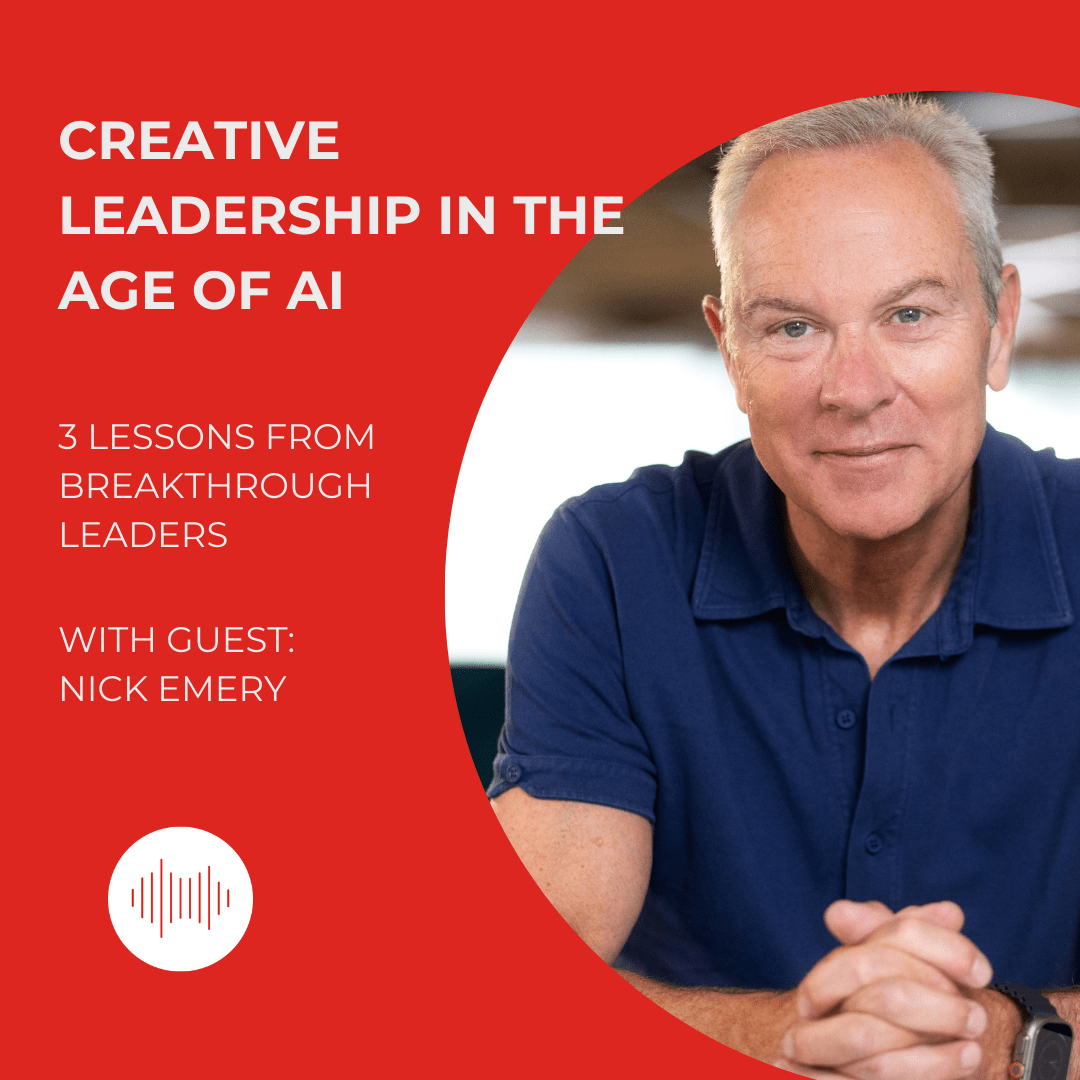
In our latest 3 Lessons from Breakthrough Leaders podcast episode, we’re joined by Nick Emery, a powerhouse in...

In our latest 3 Lessons from Breakthrough Leaders podcast episode, we’re joined by Steven Gaffney, a leading expert...