



Business Culture & Wellbeing with Janine Chamberlin
Welcome to the third episode of our...
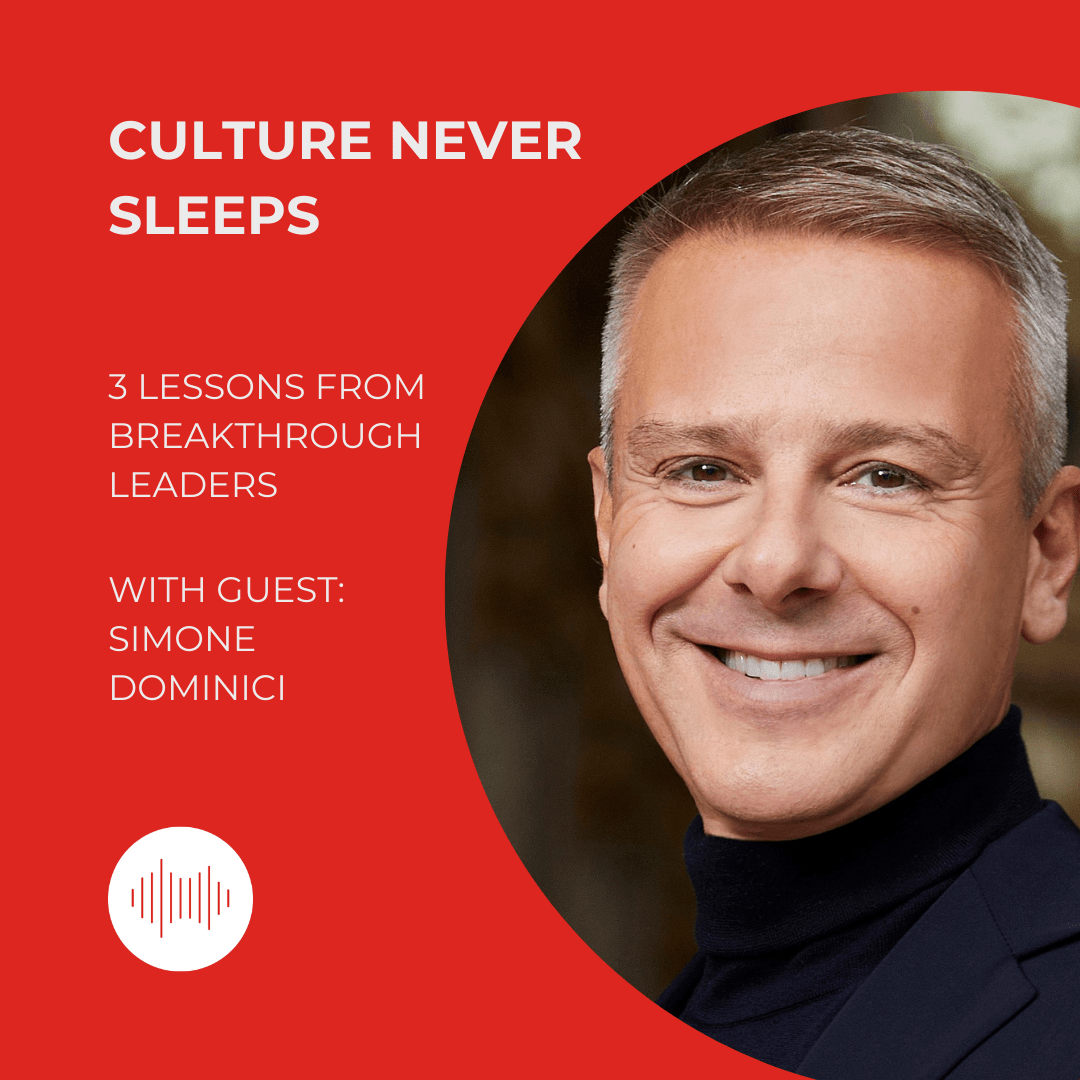
In a fast-paced world, company culture often makes the difference between success and stagnation. But why is company culture important, and how can leaders ensure it remains a priority? In this episode of Lessons from Breakthrough Leaders, we explore the crucial role of culture with Simone Dominici, CEO of KIKO Milano, whose experience across global brands offers unique perspectives.
As we discuss in this episode, company culture is essential because it creates the foundation for both operational excellence and sustained innovation. A thriving culture is the invisible force that drives both individual and collective success.
Before becoming CEO of Kiko Milano, Simone Dominici held leadership roles at Unilever, Bottega Veneta, and Coty. With three decades of international experience in luxury, beauty, and retail, he is an expert in driving business success through a robust company culture. Listen now to discover how Simone‘s expansive career has informed his deep understanding of why culture never sleeps.
What Will You Learn?
Find out more about Simone here: https://www.kikocosmetics.com/en-gb/about-kiko/governance/simone-dominici/
Lessons:
Science or Art? You need both.
Operational Excellence is Frictionless
Culture Never Sleeps
If you like this episode, you’ll also like…
Business Culture & Wellbeing with Janine Chamberlin
Welcome to the third episode of our...
Culture as Competitive Advantage with William Beau Wrigley Jr
Listen to our new podcast episode where...

Business Mastery with Pierre Laubies
Listen to our new podcast episode where...
Hi and welcome back to 3 Lessons from Breakthrough Leaders with me, Zannah Ryabchuk, CEO of Breakthrough Global. I’m here again with Dr Bart Sayle.
Hello everyone.
And this podcast is all about giving you insider tips, and the know-how from the world’s foremost leaders and creative talents. Distilling their knowledge and experience into three lessons, which we guarantee will help you and your companies to unleash your potential.
And today, we’re delighted to be joined by Simone Domenici, CEO of Kiko Milano. Simone has a vast, high profile international experience, working in consumer, luxury, beauty and retail across six countries and three continents.
And we, of course, first met you at Coty, which was a lot of fun Simone. So do you remember your experience with Breakthrough at Koty and some of the fun that we had?
Absolutely I mean, I met you just one week after joining Coty, when we have this leadership event in US. You know the first time that a new leadership team came together of the consumer division. New people, new environment, new company. And actually, it was the best way to enter the company through these two days together.
Yeah, I was in Lisbon as well. And with another milestones for the Coty journey in which it was a chain of organisation set up and moving away from the divisional to going more on the regional setup. And with another moment in which, thanks to your support, the organisation make a step up.
Lesson One: Science or Art? You need both.
What we’re interested in is some of the experiences that you can share with us, and particularly some of the some of the learnings you’ve had in your journey, which you think are critical to your growth, but you could also see that other people would value those.
No, as we share Bart, I think I can split my experience, which is 31 years. I split in a four, let’s say bucket. The first one was about the branding. Knowing how to design a brand or curate a brand, how to develop a brand with a consistent executional approach. The second one was more the science behind the business. So what does it need to be true? What it needs to be true in order to build a sustainable business, profitable business?
The third one, and then we might go through each of these steps. The third one was more the art part. How to, a brand can create desirability. How to inspire dreaming. And then the fourth one, which is started in Coty, and now in Kiko, of course, I’ve got a full opportunities to exercise. This is how to create a winning team.
This is my first role as CEO. I started in Kiko a bit more than two years ago, and then I could leverage of all this experience of the three previous buckets I mentioned in order to create the team that I believed was the right one in shaping the success of this company. But we’ll come back to this later. So these are the four main buckets in which I would divide my, my, my journey so far.
That’s a great way of doing it. And I love, I love the science and art part of that. That combination. That’s something that’s always motivated me through life, actually.
My very first part, actually, before joining Unilever, when I spent 15 years, I had a short experience as an auditor in a large multinational, American multinational. And actually, even if auditing, and let’s say PNL management, was not really what was driving my enthusiasm, it was a great opportunity to discover how to analyse different businesses, starting from their balance sheet and the PNL, something that afterward in my journey, I found it very, extremely useful.
But then after a few months, I joined Unilever, where I, my first chapter, where I can say I learned and I practised how to design a brand. Unilever at that time, was very disciplined, I believe still is very disciplined, in a way, you create a brand starting from identifying an insight and an essence of your brand, what your brand stands for, what is the purpose of the brand, and how to activate the brand along the different execution phases. Always with a high level of consistency among them, because always with consistency, you create a brand feeling that bonds the customers, bonds the audience, to what you stand for.
If you lose consistency and you use one media differently than another one, or the packaging is not aligned with what you do in a store execution, or your narrative in one media channel is inconsistent with what you say in the other one. The brand looks very blurry, and consumer at the end will be lost so consistency, discipline is as important as creativity when you want to build a brand and then you start practising what you shared before the science and art.
Yeah.
What I’m always interested in, and we talk about it a lot on the podcast. It seems to be a common theme, certainly, because it is a fundamental principle of any great leadership is around this idea of discipline. And it’s not very sexy, and it’s something that I think, particularly we see with the younger generation coming into the workforce, that is something that people want to dabble more, they want to try something, and then they want to go on to the next thing, and they want to move on and move on and move on. Bart, and I are very aligned with you that actually we really see that yin and yang of needing the creativity, but also the discipline to then go out and execute, or the discipline to understand some of the fundamental laws of what you’re going to implement to create clarity for people really. So what are some of your guide rails on discipline, and how’s that helped you in your career? Because I’m always looking for tips and advice that you’d give people on how they can put more discipline into their experience at work.
I mean my experience with myself, it works in the following way. I use my analytical skills, my love for analysis, to go deeper in understanding the real truth behind the numbers to liberate my creativity. In a way, I can’t be creative if I don’t have a solid analysis upon which I can pose my creativity, because otherwise I will be a little bit superficial and I don’t feel confident in approaching, in a superficial way, any piece of the work I do. So I really rely a lot on data. Then once the data are clear, once I really embody the data and really understood deeply, then I can liberate my creativity. Generating with this data and inside something that probably other minds will do differently, and that is, I source my uniqueness by giving the in the interpretation of this data inside with my own creativity. But again, without this part really deeply designed and engineered. I couldn’t liberate my creativity.
That is a bit the way it works for me. And then I believe it’s when you’re in business at the end, the combination of the two, again, we go back to the art inside. But it’s really part of my my journey, this balance, sometimes you tend to, privilege, I mean, to get to prefer one of the two. And there are moments in which you, your creativity, take a little bit of the overwhelm, a little bit the analysis, even if the analysis tells you something your intuition or your gut tell you something differently, and then at the end of the day, you follow your gut. But the majority of the time, the gut is really source confidence out of a deep understanding on the facts.
I particularly resonated with Simone on the idea that you need both science and art, and each empowers the other. Each is complimentary. If I look through my career, it’s always been both. Even at school, I wanted to do science and art, they wouldn’t let me do it, so I went on different paths. People now are much more ready to marry those two together, because once you’ve got those two, you’ve got you’ve got a harmony, you’ve got a balance, and balance is so important these days in many aspects of our life and our work. So that combination of those, I think, gives you a very holistic view of things, which then gives you the opportunity to start exploring in many different directions. So for me, it’s the thing that inspires. It allows me to use my intuition, but it also allows me to measure and do some analysis and fit all of that together.
So ask yourselves, are you spending a balanced amount of time in both of these facets? Most of us have a preference for one or the other, but that’s not a reason to avoid the area of our life that we have less preference in. So take some time, spend some time this week, looking at the area that maybe is out of your preference, and how you can lean into that more to ensure that you’re not missing any of the bigger picture.
Lesson Two: Operational Excellence is Frictionless.
Moving on into sort of the second stage of your journey, which was, I believe, in retail.
I switch from a fast moving consumer goods eventually you sell your brand to other retailers. When I move into a retailer role as a general manager of department store chain in Italy, with some branch as well outside of Italy, having the customer’s relation daily on the floor, you realize how much is important to take care about all the details you give less space to creating a branding experiences, and more space to have a flawless, operational, frictionless model. Imagine the part that the metaphor I use is about the oranges and the juicer.
If the juicer is not working perfectly, no matter how many oranges or the quality of the actually, you can even jeopardize the quality of the oranges even inside, because then the juice won’t be at the same level, because there is something wrong with the juicer. So retail is more about the juicer. making sure the operational excellence is in any aspect of the customer journey is frictionless. Otherwise the customer will prefer to go somewhere else. And then I moved into the luxury wars in Bottega Veneta, where still there is the retail component. Because Bottega Veneta, at that time, had more than 240 stores, so we did have a retail operation. More than a vast majority of the business was through our own stores at that time.
But then, next to the operational excellence, you learn the importance of creating a dream for your customers, and when you are in luxury, luxury is about inspiring people to follow their dreams and actually inspire people to create their own dreams, to shape their own individuality, and then when you touch the dreams, then the art components of the yin and the yang might prevail. because it’s, how do you define the colour of the season? How do you define the shape of the season? This is something that the designer does. So it was not my responsibility, it was much more in the day, in the studio, in the designer’s responsibility, but then you understand that how important it is to have no boundaries when you want to produce a piece of art.
I love what you said there, and it’s one of the things that I find so interesting about about the luxury industry, that you have this ability to quite be unleashed, I think, in many ways, in that marrying of dreaming, inspiration, creativity, to really take people to a different place, to picture themselves in somewhere that’s Different from maybe where they are to reimagine themselves and all of the language that you use there is exactly why I find it such an interesting such an interesting industry. What’s been probably your biggest learning about that, about what it takes to really inspire people behind a brand, and inspire people behind the seamlessness of operational excellence, so that it almost just washes over them, and they just come out going, Wow, that was amazing. But they can’t even really put their finger on what was so amazing about it. It was just flawless.
No, you’re right on the other side. The art will never be generating a beautiful object. Beautiful manufacturers if there is no a craftsmanship, the know-how. so at the end of the luxury is about creating this dreaming, but also designing and producing products that deliver on this dreaming. The difficulties of designing an artisanal product it’s not only in the process, but it’s more about the experience of the people, the knowledge of the people involved in the process. Which they have to select the light, the right piece of fabric, the right piece of leather. In a case, they need to know how to create the right stitches, the right elements and components. Then at the end of the day, create the physical expression of the art. Otherwise the art become, I mean, my remains too theoretical. And when you are in the luxury business, you need to be very practical, because at the end of the day, you want to wear this pair of shoes, you want to carry this bag, you want to wear this piece of weather, of a garment which is embodies, in a way, your individuality and help you to express who you want to be.
One of the biggest challenges that the team at Breakthrough have is creating what Simone was describing there. This incredibly seamless, frictionless experience that can only be realized when all of the different elements, all of those different players and parts, come together in perfect harmony. And it’s an absolute skill. It’s a challenge in every single organization, whether you’re in retail, whether you’re in the business of experiences like ours, and whether you’re designing amazing products, creating that operational excellence is the route to true excellence as an organization, as a team, and of course, in delighting your customers and consumers. and a little bit like he’s going to say, with culture in a moment, it’s a never ending journey at Breakthrough. We really believe in the power of continuous improvement and continuously looking for where are the pain points? Where can the frictions be being created? And how can we make it smoother for people? So as leaders in your organisation, it’s something you need to be conscious of all the time. What’s going on with your consumers, with your customers, how’s that journey for them? And where are the elements that you as a leader, starting with yourself, might be creating some friction, not only in your teams, but for that end user as well.
And as a leader, one of your key roles is to take the friction out of the system.
Lesson Three: Culture Never Sleeps.
So Simone, what I’m intrigued with is some of the examples you’ve talked about. Even down to the operational excellence you’ve experienced different cultures in each of these settings. How important do you see that cultural aspect?
I think when you deal with an organisation, which is probably leads me to the four pillars, the four buckets of what we were spread before, which is creating a winning team or shaping an organisation. If you don’t start from sharing the same culture, sooner or later you will lose consistency. For example, what we did when I started in Kiko was about, at that time, we were 5800 people within the organisation, the company was coming from a few years, very difficult years started way before the covid, and then, of course, through the covid, during the covid, the situation deteriorated further leave, because that time, the company was almost entirely physical retailer. And so you can imagine, during the covid, with all the store clothes, how much the business was impacted. And then we needed to create a new culture. And what we did when we started, we started by listening.
You can’t, I believe, when you enter in your organisation which already has got some history, you can’t pretend to establish a new current culture without understanding the current one, without knowing where you are. And then a survey helped me to understand what was the culture lead in this moment. But also I use the survey to do some open questions. What kind of companies you would like to design? What kind of company you will be proud to work for?
And then through these survey, we understood was the key elements of that the journey should have had in order to engage them. And then we start in designing the culture of our companies. Deciding what we wanted to stand for, what we deliberately decided not to stand for. And then it was very much liberating for people, because they understood that the first their voice was heard, the second one, they could participate in shaping the culture of an organisation, something that you don’t have so many opportunities, especially when you join a large multinational. So what we did is that we don’t ask you to adapt. We ask you to helping up in shaping it. Because at the end, at the end of the day, when you talk about culture, it looks a little bit theoretical, then you need to transform it. You need to translate it in behaviors, in something physical that the people adopt in every day life. Otherwise it stands on the walls as a disparate big values, and no one is.
So We needed to impact on the on the belief, on the behaviours, with the clear examples, we were able to, let’s say, break the silos that at that time the company had. breaking the silos the people started to understand the value of the interaction, and out of this, they started to spontaneously create the teams Culture Club. We call Culture Clubs, in which they started to share information to improve one piece of the process, for example, but already connected with the other piece of the process. Then everybody was informed. And then the overall, let’s say, ecosystem, was able to improve. And this one, it’s and we keep progressing. You don’t, you don’t. I mean shaping a culture is a daily work. There is no an end.
It’s never ending.
I mean, you have to feed every day, never ending, never ending. You need also to adapt to the different circumstances and making sure that whoever is coming, because in the meantime, we move from 5800 to 7500 people to with equally more than 1700 people in the last two years. So you want to make sure that whoever enters is also giving something, is not only receiving the culture and adapting to the caption, but also helping the overall organisation, shaping a continuous culture transformation. And this concept of transformation, never sleep. It’s quite embedded now in the organisation, and especially in a younger part of our population. We have a company quite young. Our average age is 29.8 so not even 30 years old. So it’s quite I’m very happy, I’m very proud about the spirit that today is lived in our organisation.
How would you describe the spirit? What would be your sentence to kind of sum up what that spirit feels like to work there.
In a way, there is this positive feeling of being an underdog. We are not the leader in the beauty industries, but we are growing much more than many big players. Even when we started to grow triple the speed of main competitors, we kept this under the attitude which helping us to stay humble, stay hungry, of course, but now with the more confidence about our opportunity, our possibilities and our capacities. And that is an important element which is not easy in your organisation and in you as an individual, how to keep stay humble while feeling confidence, because the risk is when, when you raise your confidence, you become a bit more arrogant.
This is a, I mean, I know I’m going to another to another practices, but take, for example, tennis, which is a passion I have. I don’t know if you have, if you have follow the latest victories of Sinner, an Italian tennis player. Which is one of the best example of someone who has gained confidence in the last years because he has won so many matches against the top one, top two and top 10 players, but still stay very humble. Still focus on practices, still focus on discipline, back to the discipline. And this is an element that you as an individual, and more important as well with an organisation, is one of the key of success. To me, of an organisation, stay humble while gaining your confidence.
Nurturing and shaping your culture, for a leader is never ending. It’s a never ending journey. And while many people think that leadership is about something else, is about strategy or about organization, what’s key is the culture. The culture is what will bring you to success. It will help you grow. It will make you resilient. It will make you creative. So time spent on your culture is time well spent. And one of the things that Simone brought out is that culture is everybody’s role. It’s not just the leaders, but it’s everybody in the organization. And the more you can give people a role in shaping the culture, nurturing the culture, strengthening the culture, the more they’re involved in what you’re building and who you are and how they’re engaged.
So as a leader, think about what are you listening for in the conversations that you have with your people and with your teams, and is there a forum where they’re able to express how they believe they can contribute more to their culture, what your culture maybe needs to evolve into, and where certain things are creating more friction in terms of that culture? And make sure you’re really listening for those possibilities, so that you can get that engagement across a broad number of people, and then be able to go and implement it.
All right, so this is the part of the show where we ask guests a series of Hot Seat questions. So we want your immediate, quick fire answer. Are you ready?
Yeah, go shoot.
Awesome. What’s the most exciting thing you’ve ever done?
Writing a novel?
Wow, tell us about the novel.
Yeah. No, I wrote a book 15 years ago. It was published by a foundation, an airline foundation. But then recently, I wrote a novel, and actually which has not published yet, because I have to still to find, I have to find a way to really sharpening and crafting better. But actually, the beauty for a non professional writer is not about publishing. Is about liberating my creativity while writing. So it’s one of the example with the journey is much more important than the destination.
And if you could finish this sentence for me: Success is…
Having an impact. Which is at least equal to the expectation. Better if it’s above expectation.
And finally, if you could only take one book to a deserted island. What book would you take with you?
It’s a Spanish book. I don’t know if you know it. It’s the Shadow of the Wind.
That’s so weird when you were talking about writing your novel, that’s the book I had in my head.
Okay, that’s great.
That’s bizarre.
That’s telepathy. That’s telepathy. Because I lived in Barcelona when I was in Unilever. I moved from Italy to Spain and lived three years in Barcelona. And if you have read the book, this book is, I mean, the setting is in Barcelona, I may think is a I really enjoyed. I have read maybe four or five times this book.
It’s an absolute page turner. And in fact, I remember when my dad was in hospital years ago, I brought that for him to read, and he was kind of, you know, when someone’s not aware and they don’t really want to do and he sat and he read the whole thing, and I went back the next day, and he’s almost finished it. He said, “Oh, that was a great book.” It’s excellent.
It locates you in a different environment. You really you disconnect with the reality, and you in the hardest moments is very thick, but in a few days you want to finish it. So it’s good for the holidays, not for the working week. Good
Good for the desert island.
Absolutely.
It’s going on my list.
Well, thank you so much. It’s been such a pleasure, and for me, I’ve learned a lot. Particularly that yin and yang that I know to be true, but to hear it reiterated again and in the way that you’ve worded it and taken us through those, those key kind of pillars of your leadership story, it’s really resonated with me, and I know certainly will have resonated with Bart as well. So thanks so much for coming on. Thank you for indulging us with your conversation.
And thank you Zannah and Bart.
You know this conversation you are. You are a philosopher. Thank you Simone.
So thanks again for joining us. Remember to hit the subscribe button and join us again for our next set of Lessons. And if you’ve got any questions or comments, email us at bartsayle@breaktrhoughglobal.com or connect with us directly on LinkedIn at Breakthrough Global.
We’d love to hear your own leadership stories. And we’d also love for you to share this episode on your own social media and review and rate this podcast on your player of choice.
Thanks to our production team, Julia Soltysova at Breakthrough Global and Robin LeeBurn at Fairly Media and of course, thank you for listening.
Welcome to the fourth episode of our podcast, 3 Lessons from Breakthrough Leaders! In today’s episode we’ll hear...

Welcome to the first episode of Series 2! We kick off this new series with an inspiring...
Lessons from Breakthrough Leaders: 3 key takeaways on Unleashing Potential In a rapidly evolving professional landscape, linear...