



Why is Personal Development Important? With Elizabeth Uviebinené
Welcome to the first episode of Series...
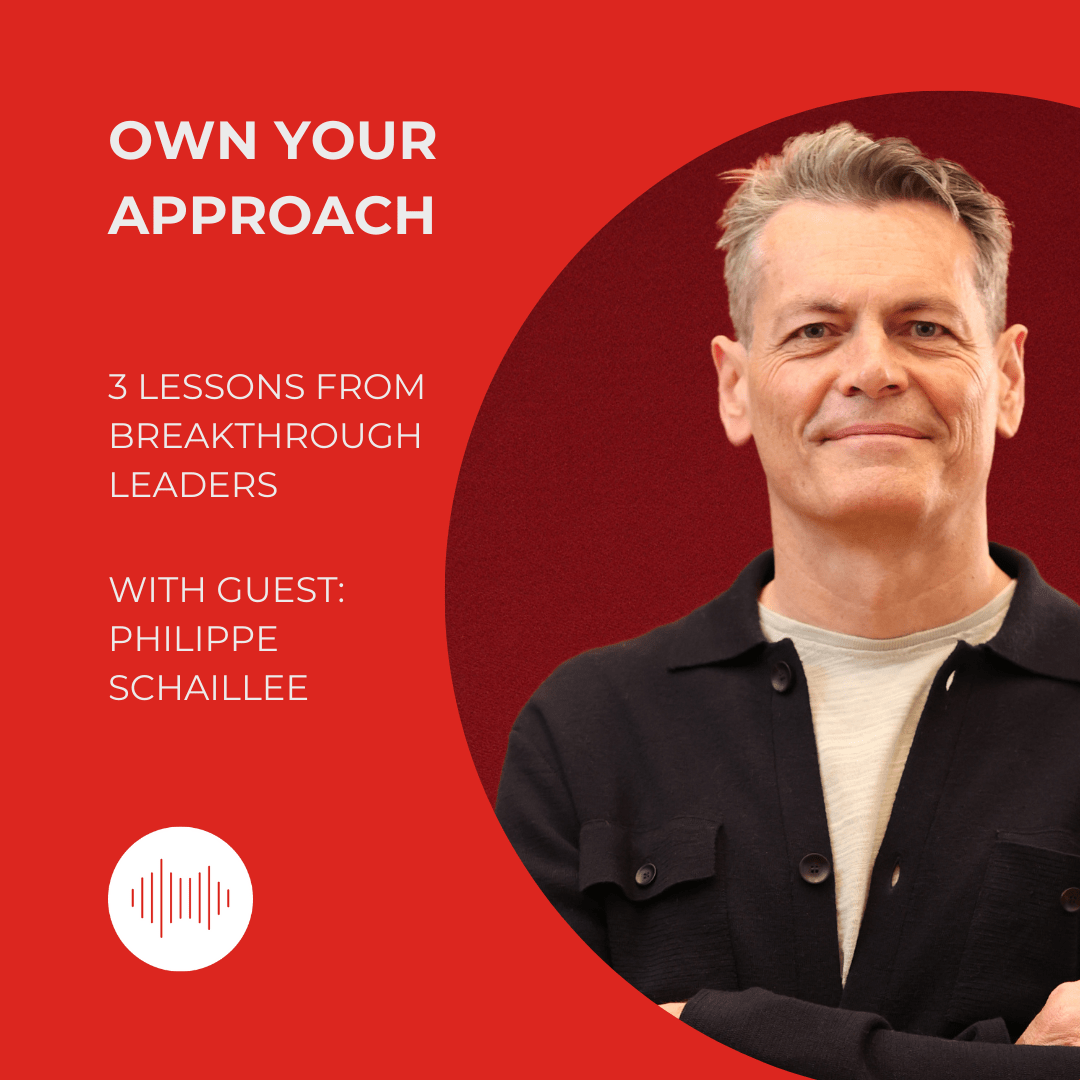
In today’s fast-evolving business landscape, resilience and innovation are key growth drivers of success. But how do industry leaders cultivate these qualities in the face of challenges? In this episode of Lessons from Breakthrough Leaders, we sit down with Philippe Schaillee, CEO of Costa Coffee, to discuss the critical role of failure, balance, and personal leadership in driving long-term growth.
As Philippe shares in this episode, embracing failure is essential for unlocking innovation, while building a leadership approach that stays true to your strengths can help sustain growth and resilience. Balancing the pressures of the business world with personal fulfilment is the foundation for thriving leadership.
Before becoming CEO of Costa Coffee, Philippe Schaillee held top leadership roles at Groupe SEB, Jacobs Douwe Egberts Peets (JDEP), and Sara Lee, where he spearheaded major initiatives in marketing and strategy. His extensive experience across global markets in Europe and the U.S. has given him a unique understanding of how to lead through both challenge and opportunity.
Listen now to learn how Philippe’s journey has shaped his approach to leadership, and the power of failure in the F&B industry.
What Will You Learn?
Find out more about Philippe Schaillee here: https://www.linkedin.com/in/philippe-schaillee-40196b1/
Lessons:
The Power of Failure
Build An Approach That's Yours
Growth Thrives on Balance
If you like this episode, you’ll also like…

Why is Personal Development Important? With Elizabeth Uviebinené
Welcome to the first episode of Series...
The Importance of ESG Strategy with Tony Kypreos
Lessons from Breakthrough Leaders: 3 key Lessons...
Squiggly Careers with Helen Tupper
Lessons from Breakthrough Leaders: 3 key takeaways...
Zannah Ryabchuk
Hi and welcome back to 3 Lessons from Breakthrough Leaders with me, Zannah Ryabchuk, CEO of Breakthrough Global. I’m here again with Dr Bart Sayle.
Bart Sayle
Hello everyone.
Zannah Ryabchuk
And this podcast is all about giving you insider tips, and the know-how from the world’s foremost leaders and creative talents. Distilling their knowledge and experience into three lessons, which we guarantee will help you and your companies to unleash your potential.
Today, we are absolutely delighted to welcome Philippe Schaillee, and I’m delighted, because I’ve known Philippe now for several years. We worked together first when he was at JDE, and I must say, was slightly skeptical of our approach. And luckily, we won him over, and now we’re working with him, of course, as the CEO of Costa Coffee. He is an inspirational leader. He is very clear, he is very concise. He knows about the purpose. He knows the importance of that when building an organisation, and he also really understands the value of people in driving change and in driving results. So Philippe, welcome to the show today.
Philippe Schaillee
Thank you. Great to be with you.
Bart Sayle
Hello, Philippe. It’s good to see you.
Philippe Schaillee
Hi Bart.
Zannah Ryabchuk
So Philippe, kind of the big one to start with. If we think back around your incredible career, what inspired you to actually start on this journey and to get into the world of business as you are now?
Philippe Schaillee
Yeah, I think it was very similar to many other kids. I had a dad who had an international career, who started in marketing and looking up at his accomplishments, I wanted to follow in his footsteps. There were three things early on that were clear in my aspiration. One, I wanted to go into marketing in FFCG. Two, I saw General Management as a career ambition. And three, I wanted it to be international. I looked at my dad travelling around the world, and almost like I want to do that too. You know, you’re inspired by your parents.
Bart Sayle
Lesson One: The Power of Failure.
Bart Sayle
You mentioned your dad, and he was a great influence on you. What are some of the things you can tell us about what you learned from him?
Philippe Schaillee
Oftentimes, you learn most from failure, right? And I saw my dad being very successful in his career progression, but also at a certain moment, be confronted with a company that he was working for where he had just become General Manager go bankrupt. Totally outside of his control. And just observing how he had to absorb the stress and communicate to his family just serenity and just the Energy and the belief and the confidence that he would be able to overcome that is certainly something that has marked me, and that allowed me, early on in my career, also to be able to adopt and absorb some challenging situations.
Zannah Ryabchuk
And who else do you think has been a big influence? So clearly your father. Were there other important key mentors or leaders along the way that you thought, ‘Wow, I really love the way that you’ve done that. I wish I can emulate that one day.’ Or maybe some where you thought, ‘Hey, that’s definitely not the way to do this,’ and I’m going to learn that I’ll do it a different way.
Philippe Schaillee
I’ve been super lucky. I’ve obviously had mentors who really believed in me at different stages of my career, and that I’ve learned a lot from. Adrian Nuhn, who was the CEO of Sara Lee coffee and tea. A second one was, was kind of a duo, the CEO and the COO of Sara Lee, North America, CJ Fraleigh and Monty Pooley. And the last one is somebody that you’re I think you both also know very well the first CEO of JDE, Pierre Laubies. Super inspiring, smart, intelligent leader who was incredibly gracious in sharing his wisdom.
Zannah Ryabchuk
And the shameless plug for that, of course, is that you can listen to Pierre’s podcast. It’s a great episode, actually, and we love talking with him.
Bart Sayle
Philippe, I’d like to stay with young Philippe. Not that you’re – you’re still young, but you know. I look back in my life, and if I was to look at the first experience I had of being a leader. Although I never, ever would have called it that. Then I was in the boy scouts. And of course, we had a Scout master, Scout leader. But then I was put in charge of one of the patrols, and I can still remember the we went on this month’s camp, and that’s where I really started to experience what it was like, where people actually started depending on you. And I was just wondering, if you look back through your lifeline, what were the early experiences you had, which now you could say, yeah, they were that they were the start of me experiencing leadership.
Philippe Schaillee
It always become linear when you look back, but it isn’t when you start right. It’s funny, when I was a kid, all the kids, I mean, would be playing football, attendance, or whatever, building camps. But then there was this one kid who decided that we would organise this whole Olympics over multiple days, and everybody would join. And they would be looking up to to me leading that. And then fast forward, 10,12,13 years later, as a student, I wasn’t necessarily looking for it, but people would ask me, propose me, to become the president of a student association that was that was founded. And I did it for a year, and I loved it. And then after, I was looking for a successor, and they basically convinced me to do the second year in a row. And so I just rolled into it, and probably at that stage, started to realise this is something, one that I like. And apparently, people think that I’m pretty good at it, so maybe I have to do something with it.
Zannah Ryabchuk
And thinking about what you were describing before. Of you know, it looks linear looking back, but it’s not always so linear on the journey. What have been the sort of most defining moments of your career? Maybe some of the amazing successes, but also some of the failures. Because, as you also believe, you know, we learn the most from our failures. So what have those been? Can you kind of pinpoint them?
Philippe Schaillee
Yeah, no, absolutely. I’d start with a failure. And oftentimes people are surprised, because you start with that. I think as leader, it’s important to show vulnerability. This failure actually happened when I got, indeed that job to move to the US. A marketing director based in New York, the dream job of every marketer that was working for Sara Lee at the time. And just before leaving, I had this conversation with one of my other mentors, a gentleman called Christian Ramizin, who told me, ‘You know what, Philippe, I am absolutely believer that you’re going to be super successful, but I also give it a 50% chance that you’re going to be a total failure your first year.’
Wow, that’s a surprise. So he explained me, ‘You know what, you’re you still have to learn to become kind of politically agile in a bigger organisation. You’re a big idea guy, but you haven’t worked in a tough environment where every little detail works. So I have to see how you’re going to adapt into this environment Where you’re not going to be working for a company that is market leader, but where you’re going to be a challenger in a huge market like US.’ And I like, Okay, I got it good advice. I got on that plane to the US, and all I heard in my head was, ‘You’re going to be super successful.’ I’d totally forgotten about the other advice and six months into the job, I was failing. Because I came in, I have my recipe of leadership or leader brands, and I was working on small brands against very big competitors, and my recipe for success was not attuned to that new situation. And on top of that, I was burning bridges, because, indeed, I was not very politically sensitive. And the defining moments became when I basically mentally told myself, ‘I’m done with this. I’m just going to go back to Europe. They’re not understanding how I work. They’re not doing the right things I am right.’ And where my wife is basically telling me, ‘Seriously? I mean, I remember that feedback that you got. Are you sure that there’s no opportunity for you to adjust?’ And I did. I adjusted, and it got me back on track, and it became foundational for my future career. So I’m very happy about that.
I think a second defining moment was indeed when those two American gentlemen, CJ and Monty, gave me that opportunity to step out of my comfort zone in coffee, and step into all of these other categories. And it just it pushed me up so much in my in my career, to the next level. And then I think the last one is between a success and a failure. It’s an environmental failure, which was when I was a JDE leading an away from home, a professional coffee business, and you had Covid hitting and, of course, an away from home business gets heavily impacted by this. And you’re confronted with the sky is falling, your business goes down by 70, 80% from one week to the other, and you get a lot of pressure to basically take shortcuts. To to do things that are maybe not 100% in line with the values that you have. I think they’re the defining moment for me was to make a decision that I would always have people’s the best interests, of organisation, of our associates in first of all, in mind, even though that would mean that you would have to lay off people, but always doing that in a very respectful way. Because that’s the right thing to do, and that’s always finding that right balance is something that has been pivotal for me also in the rest of my career.
Bart Sayle
That really is the Power of Failure, as I call it, for me in my business career, certainly. You know, I was in the corporate world, and then the first business I started after that, we went bankrupt within about nine months. And I can remember, I was devastated at first. I’d never really had a failure, certainly in business, I hadn’t. But now, when I look back on that, that’s one of the most amazing growth experiences I’ve ever had. And it was after that that I started Breakthrough.
And like Philippe, I know that whatever happens, I’ll be resilient to get through it. What it makes me think as well is that failure is such a loaded word. You know, people fear failure, I think because it is so loaded. When really, when I look back at what I just called a failure, it wasn’t me that failed. Something failed, the business failed, but I didn’t fail. And I think if I’d have come out of that with the interpretation that I had failed, then I wouldn’t have got the benefits from it. I would probably still be fearing anything that comes close to failure. But what I did realise is that it wasn’t me that was failing. It was something else, and all I had to do is learn from it and act on it.
Zannah Ryabchuk
So ask yourself: Where have you failed? What have been your big keystone failures? Maybe it was professional, maybe it was personal. And what have you been able to learn from them? How have you grown? How have you developed? And how have you ensured your resilience in the face of further failures in the future as a result of your learnings from those keystone experiences?
Bart Sayle
Lesson Two: Build an Approach that’s Yours.
Bart Sayle
What are some of the things now that you consciously want to impart to other people in our audience. We’ve got leaders listening, and we’ve also got young, up and coming leaders who really are looking for experience. They’re looking for mentors themselves. They’re looking for how they can progress and how they can develop with the people that you work with. What are the things that you want to impart to them?
Philippe Schaillee
Yeah, I think there’s, there’s a couple of things. First of all, I’m pretty consistent in the leadership principles that I convey to every team that I work with, and I do it from day one. It starts with integrity. There’s just no no shortcuts. It’s followed by accountability, personal, individual accountability, discipline is really important to me, simplicity, which is something that people are always a bit surprised by, but it’s just so much easier when simplicity is a core value. And then, of course, teamwork that I combine with with the saying. And I would never have thought that I would use this person as as a benchmark for quotes Dwayne Johnson, the Rock who said, ‘Always, always, always be the hardest person working in the room.’ But I think it’s so true. There’s just no shortcuts from that perspective. And then the last thing. I was making the analogy between building a brand, building leadership brands, and building your own leadership brands. I’m a true believer that there is this opportunity to define who you are standing for. And what your purpose is and what your positioning is, and based on that, build your career path. But always stay very close to that personal leadership brand identity that you have built.
Zannah Ryabchuk
What are some of the other principles? So you’ve described some there. Are there any other important principles that we could learn from you? I know that we’ve covered a few previously. Is there anything else?
Philippe Schaillee
I think everybody learns at some point, after 20,30, years of career, you start building an approach that is yours. I don’t know if this is the case for everybody. You probably have people who are really good at startups and scale ups, and you have people who are really good at high growth. Smaller companies are probably been most confronted with turnaround jobs. And so I built my model, which is not, it’s not rocket science, but it has a couple of elements that that always come back. First element is just always knowing where you are before you decide where you go. It’s fundamental knowing your point of departure and within that, and it’s funny, in every company where I come in, it’s always a bit of an aha moment or oo moment when you confront them with that. That this quote from Edwards Deming, ‘In God, we trust. All others must bring data.’ It’s like, ‘Oh, okay, makes sense. But that’s not necessarily how we were working.’ So just being so factual, so data driven in the diagnostic understanding the point of departure before running and rushing into all kinds of directions. That’s number one.
Number two is always starting with first, fixing the fundamentals. Great quote from Pierre, ‘First better, then bigger.’ I’ve reused it many times, and it’s always resonating with the audience. And it’s funny enough, usually something that they’ve never heard before, but they immediately connect with it, and it becomes just a mantra. Just, let’s make sure that we first fix the fundamentals. And then, as you’ve built that foundation, and you want to accelerate what I call building better and bigger, just not forgetting what those fundamentals are while you’re accelerating the business. It’s so easy to start growing again and then having to redo the turnaround and rebuilding the fundamentals. And finally, while you’re so strongly focused on that growth, not forgetting to build a high-performing, engaged and winning team. It’s the biggest foundation of success, of structural success, and always absolutely obsessed by it.
Bart Sayle
One of the factors contributing to Philippe’s success over the years is that over that time, he’s been building an approach, which he can now say is his approach. And he’s fashioned this from his experience, from lessons he’s learned from his mentors, from his failures, as we talked about, but now he’s very clear that he has an approach. So whatever assignment, a new assignment, he goes to, he can bring in this tested methodology that he knows will work. So ask yourself, what is your approach? What’s going to guarantee success for you as you go forward?
Bart Sayle
Lesson Three: Growth Thrives on Balance.
Zannah Ryabchuk
I’m thinking as well, Philippe, back to the beginning of this conversation. And you being inspired by your dad internationally travelling. And of course, you now are on the road an enormous amount of the year, right? So how do you maintain a balance within that? Because you’re working extremely hard, you’re working really hard to deliver results. You’re also thinking about the people in your organisation at the same time. How do you recharge? How do you manage your energy? And actually, the thing I always love to find out from people such as yourself is a bit of a specific one. What are your tips for international travel? That mean that you can get off the other end of a 12-hour flight and go and do that meeting and be okay because most mortals can’t do it.
Philippe Schaillee
Yeah, I mean, the first thing is, my weekends, my holidays are really for family, friends, social life. So it’s it’s disconnecting. For the longest period of time I thought that I could do both. So during weekends, during holidays, I could, of course, you can check those emails, and it’s really not having an impact. Until I didn’t for a couple of days or for a week, and I just realized how much more you’re just re-energizing, truly, really having that mental disconnect. So, I mean, the biggest thing to create balance for me is my family, my friends, my social life thing. The second thing is sports. Funny enough, the longer my career has been, the more I get obsessed of making sure that I have my four or five days of sports in for the week. Because the more it’s becoming important to be able to absorb the business intensity. And then, other than that it’s just finding the time to read relaxing. It takes your mind off things. And in combination with listening to music I think those that’s probably it.
Bart Sayle
So if I brought that back to leadership, do you encourage your people to do similar things, to actually take weekends as a break? Because I’ve known, with leaders who actually demand attention at any time. Round the clock, over weekends and so on. And, you know, I’m thinking of one now, and basically, you know, the whole culture was affected by their behaviour. And so your behaviour is such a great model and such a great role model for people. Is this something you communicate? Is this something that you encourage?
Philippe Schaillee
Probably not enough. But here’s what I am doing consciously. Normally, I prepare my week on Sunday evenings. What I usually do is set up, kind of put my outbox offline so that on Monday morning, the emails that I’ve written on Sunday night go out. Because I’ve learned early on that when people get those emails on Sunday night and that thing that is expected from them.
Bart Sayle
That’s right.
Philippe Schaillee
You know? So.
Bart Sayle
that’s really what I was – that’s what I was getting at.
Philippe Schaillee
Yeah, so that’s important. And then also holidays and people in the team. I mean, they’ll always say, ‘You know, we’re reachable.’ You know? I mean, ‘Of course, I’m on holidays, but I’m reachable.’ No, no, no, you don’t have to be reachable. If there’s really an emergency, which there probably isn’t going to be, then we’ll find you. But just those couple of weeks a year, they’re critical. Use them well.
Zannah Ryabchuk
And I’m thinking now about Costa, actually, and a question I wanted to ask for, for selfish reasons, to do with a very important decision that you made, and some of your colleagues would have been involved in, which is around the 50/50 gender split that you have on your executive committee at Costa. And in the 12 years I’ve been at Breakthrough, there’s been a dramatic change, I would say, in the last two years. So before the last two years, I hadn’t worked with a single 50/50 split executive committee. In fact, I would say 95% of the executive committees we worked with, you’d have the one token woman, probably usually from HR, kind of there, and usually not really being able to speak up very much actually. Which is kind of shocking. But in the last two years, it’s genuinely changed. I mean genuinely changed. And now it’s becoming more more the norm. Why was it important to you to have that level of diversity? Because it’s not just about gender diversity for you. You’ve got a really diverse team there.
Philippe Schaillee
My real objective is to represent our consumers in my executive team. Our consumers are global, and we were with Costa. We’re active in close to 55 countries in the world. I want to represent at least the biggest geographies, and I want to represent the fact that our consumers are female and male. So we wouldn’t make any sense to have 100% UK male, pale and stale executive team, right? So it’s with that intent, but always also obsessed by not making any concessions on quality that we moved into the direction of a more international and a more diverse team, both from a gender perspective and from a from a nationality perspective. And it’s working super.
Zannah Ryabchuk
So like all of the high-performance leaders and high-performance teams that we work with, Philippe has really recognised and learned to be true, the extraordinary value of generating balance in your life. You are not able to perform at your peak, at those moments in life where it really matters the most, if you’ve not recharged fully and prepared for that moment. And he’s given us some excellent tips and techniques there of how he maintains his balance. So think for yourself. What works for you is it sports? Is it spending time with your family? Maybe it’s reading a good book. Maybe it’s something as simple as going for a walk. But be very clear. What are these tools in your personal toolkit, and it’s different for every single individual, that enable you to generate that balance, generate that calm and to be able to recharge fully in order to perform at your best?
Zannah Ryabchuk
Okay, all right, so now it’s time for the Hot Seat questions. Are you ready?
Philippe Schaillee
Of course.
Zannah Ryabchuk
Of course. Cool as a cucumber, as always. What inspires you in life?
Philippe Schaillee
One word, growth. It’s inspiring to grow yourself. This, notion of eternal learning. I mean, hopefully I can live as long as I can, because every day is a learning moment. It’s growth in terms of seeing your kids grow, your family grow. That’s fantastic. It’s fascinating, it’s inspiring. And it’s amazing and always energizing to grow a business.
Zannah Ryabchuk
And finish this sentence: Success is…
Philippe Schaillee
Success is winning with and through a high-performing, engaged organisation while still maintaining a balanced life.
Zannah Ryabchuk
I love that. And of course, if you could only take one book to a deserted island, what book would it be?
Philippe Schaillee
That’s a tough one. There’s one professional book and there’s one personal, more fiction book. Professional is a book I read probably 20 years ago, ‘Eating the Big Fish,’ because oftentimes I’ve worked on challenger brands, and it’s always inspiring me in the way of thinking, changing the frame of reference, and that way working around the competition. In terms of fiction, it would be the Quincunx from Charles Palliser. Also,
Bart Sayle
Oh, wow, yeah.
Philippe Schaillee
Another recent book, but I love historical fiction, so it’s an amazing book.
Bart Sayle
I’ve never heard anybody talk about that before. The Quincunx.
Philippe Schaillee
Oh, really? Okay.
Bart Sayle
Yeah, yeah. It’s a great book.
Philippe Schaillee
An amazing book.
Bart Sayle
Philippe, thanks so much. This has been such a great conversation, and I just feel I know so much more about you now, and that’s lovely.
Zannah Ryabchuk
Thank you.
Bart Sayle
Thanks for being so open, actually. Very open. Thank you.
Zannah Ryabchuk
And also thank you for sharing your failures and seeing that value of vulnerability, because it really does make a difference. And is, I think, one of the most valuable things that we can teach people on this podcast is that most of the top leaders out there have only got there because they failed in lots and lots of different ways and learned from it. So we really appreciate that. Thank you.
Philippe Schaillee
Super. It’s a joy.
Zannah Ryabchuk
So thanks again for joining us. Remember to hit the subscribe button and join us again for our next set of lessons. And if you’ve got any questions or comments, email us at bartsayle@breakthroughglobal.
Bart Sayle
We’d love to hear your own leadership stories. And we’d also love for you to share this episode on your own social media and review and rate this podcast on your player of choice.
Zannah Ryabchuk
Thanks to our production team, Julia Soltysova at Breakthrough Global and Robin LeeBurn at Fairly Media and of course, thank you for listening.
Why is company culture important for long-term business success? In a fast-paced world, company culture often makes...

Listen to our new podcast episode where we explore how Wrigley’s cultural transformation took them from a...
Lessons from Breakthrough Leaders: 3 key takeaways on Unleashing Potential In a rapidly evolving professional landscape, linear...