



Breakthrough Leaders Unlock Potential with Gilles Morel
In our latest 3 Lessons from Breakthrough...
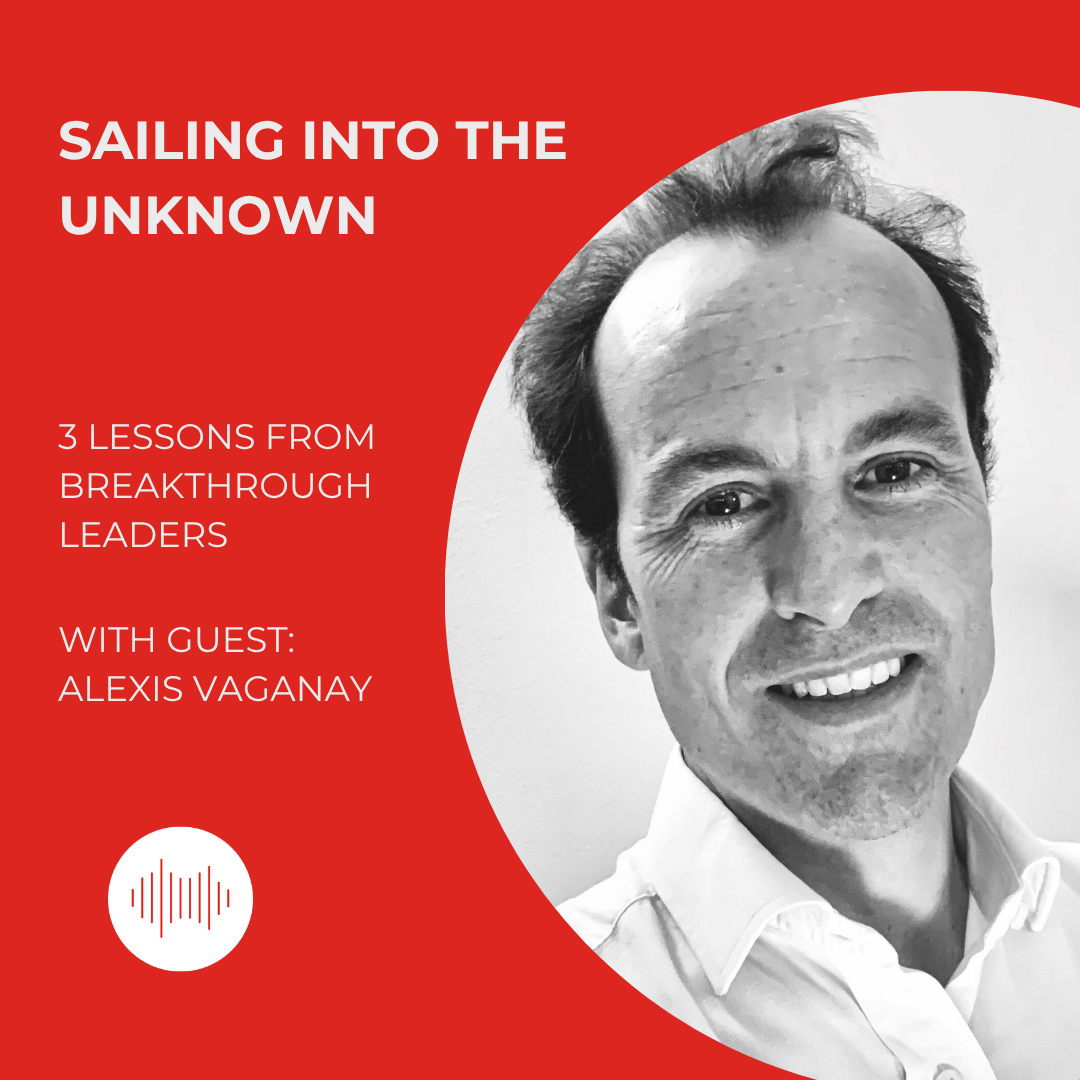
In our latest 3 Lessons from Breakthrough Leaders podcast episode, we’re joined by Alexis Vaganay, Global CCO at Coty. With nearly 30 years of international experience across FMCG, he has worked in high-performance environments spanning across all five continents.
Recognised as a thought leaders and an avid competitive sailor, he has led the transformation of multiple businesses, generating over $2 billion in revenue through brand elevation and effective digital strategies.
In this episode, we explored 3 lessons with Alexis:
1. Mindset & Team – The Multiplier for Success
2. Sailing Through Uncertainty
3. Fail to Prepare, Prepare to Fail
This podcast brings you genuine, inspiring conversations with extraordinary leaders, many of them Breakthrough alumni, who are proving that business can be a force for good. Created with purpose, not profit, it’s designed to spark fresh insights and help leaders at all stages make an impact.
Find out more about Alexis here: https://www.linkedin.com/in/alexisvaganay/
Lessons:
Mindset & Team - The Multiplier for Success
Sailing Through Uncertainty
Fail to Prepare, Prepare to Fail
If you like this episode, you’ll also like…

Breakthrough Leaders Unlock Potential with Gilles Morel
In our latest 3 Lessons from Breakthrough...

Business Mastery with Pierre Laubies
Listen to our new podcast episode where...
Culture as Competitive Advantage with William Beau Wrigley Jr
Listen to our new podcast episode where...
Hi and welcome back to three lessons from breakthrough leaders with me. Zannah Ryabchuk, CEO of breakthrough global, and I’m here again with Dr Bart Sayle.
Hello, everyone.
And this podcast is all about giving you insider tips and know how from the world’s foremost leaders and creative talents, distilling their knowledge and experience into three lessons, which we guarantee will help you and your company to unleash your potential.
We also have some big news. Our new book, Energy Driven Transformation: A CEO’s Guide to Momentum, Impact and Growth, will be published in September.
We know so many of you are struggling with change fatigue in an ever transforming reality at the moment, and so we can’t wait to share this book with you. Look out for further announcements later in the year.
And in today’s podcast, we are joined by Alexis Vaganay.
Alexis has nearly 30 years of international experience across FMCG. He spent the last decade in the beauty space at Koti, and he’s worked in high performance environments spanning across all five continents. He’s led the transformation of businesses generating over $2 billion of Euro, particularly through brand elevation and effective digital strategies. He’s a recognised thought leader who’s passionate about people. He has four kids and loves sailing competitively during his leisure time. And today we’ll learn these three lessons from Alexis.
Mindset and team, the multiplier for success. Sailing through uncertainty. Fail to prepare, prepare to fail.
Lesson One, mindset and team the multiplier for success.
With your leadership experience. Our audience is very interested in the experience that you’ve had, and you can share with us, and particularly in what you consider the importance of a leader’s true north, the direction, the purpose.
I’m a sailor myself, and when, when you sell, you have to use a compass. And I love this analogy for business. For me, you know, steering a business and a team is all Bart, holding firmly a compass, setting course to a very clear destination that everybody understands. So that’s why, to me, it’s the starting point of leadership. So it’s a type of navigation. Yeah, it is, because, you know, business and leadership is always about going to a destination and setting course, but also weathering some storms, managing, you know, unpredictable situations. So it’s really a journey which is all about making sure you don’t lose your North Star, and you know exactly, despite all the circumstances, where are you going to what you’re trying to achieve.
And what, what do you see as the current reality these days, of the sorts of companies that that you’re in and that we work in.
The analogy is always about weathering storms, right? When you think about the sequence of the past five to six years, we all had to really weather some storms, some really rough seas and difficult weather, but only they were tough, they were also unique and uncharted waters. To use this analogy, right? So we all had to really improvise at times. What I found very useful is to really have a compass and understand very clearly what was my destination still, because it’s easy to lose sight in midst of crisis of what you’re trying to achieve, because you’re managing the short term, but actually it’s much easier to do that when you are super clear on what you’re trying to achieve on the longer run.
How do you keep your crew together during those uncertain times? How do you keep them motivated and facing the direction you want them to go?
It’s a big challenge, and every time we have to reinvent ourselves and find new ingredients the recipe. But first, in those circumstances, you feel a high stamina, because you have to get through right, so we can galvanise ourselves by really making sure we get through together. And that gives a sense of purpose, which creates some bonds. And I think a sense of togetherness, which is very unique. But of course, the more you use that stamina, the more exhausting it is. So you need also to, once you’ve weathered that very tough situation, collectively, you also need to acknowledge that you you need to reflect, slow down the pace a bit, repair what’s broken, reassess the situation for setting the new course to the destination. So it’s, I think the one shot is exhaustion, actually, especially after the six years we went through all together.
So let’s look at that. So two things really from you personally. How do you avoid that exhaustion? Or if you are exhausted, how do you then renew and recover yourself? You’re a sailor. I’m a I’m a mountaineer and a semi retired mountaineer, but in my heyday, one of the things we didn’t really understand at that time, and it’s well understood now, which is why climbing is getting so they’re doing amazing things, and one of the reasons for that is certainly the training, but more so that people have discovered how important Recovery is that actually just going full belt all the time, it’s not going to work, and you actually have to have those periods of recovery. So how do you build that in for yourself? But also, how do you build that in as a leader for your people?
Okay, so on a personal front, I think you know, what energises me is, of course, family time. There’s a sense of fulfilment whenever you are with your family that is unique and super helpful to recharge your batteries. Socialisation is, in the same vein, very important to me. That’s more for the spirits, but also for the body, it’s more about sport and yoga. The second thing is, when it comes to the team, the fact that we need to also recharge collectively, which is different, I think it comes through the clarity of purpose that you get about the destination and the picture of success that you’re trying to reach. And I think when you gather everyone around the same kind of goal, reflecting on the journey so far, and all the rough seas and storms that you we weather together, but also enjoying what’s next, a new chapter in their journey is something that can galvanise again and recharge as well.
Yeah, yeah. You know, one of the things that we’ve talked around and implied but not actually explicitly mentioned, is is energy. You know, how important is your leadership in energising not just yourself, but your team, the organisation, and any transformation that you’re going through?
You know, Bart, when I reflect on the greatest leaders I’ve had myself, they share the same trait, which is around being net exporter of positive energy, and this is something I try to replicate as much as I can. Of course, we are only humans, but generally speaking, I think it’s important to remind ourselves that actually, as a leader, everybody scrutinise you, you, what you do, how you look, and the climate that you create around you. And of course, the challenge I give to myself is to be a net exporter of energy and positive energy, more importantly. But on energy, I think one of the tasks that we have on hand as leaders is to really liberate those energies. More often than not, they are trapped. And a lot of people lose their sense of purpose because they feel that they don’t make a difference and they cannot take initiatives, or, you know, on behalf of the business. So by liberating those energies, you have a chance to really actually add more strengths and stamina to the mix collectively.
What would I have to do as a new, upcoming leader to make sure I’m not blocking energy and I’m doing as much as possible to liberate energy with my team and my organisation?
So I can share what I’ve tried to do and achieve. I’m not sure this is the recipe for success, necessarily, but for me, it starts resetting the direction, making sure that everybody understands where we’re going, and then to support each other, because you need to have the back of your own teams. If I take I dare to use the analogy of the army, this is what it’s all about. All you want to know is to what are we doing here? What is the goal? And do I have the back of my fellow soldiers and friends?
What impressed me about Alexis is the fact that he does competitive sailing across oceans, and he’s able to use the mindset that he uses in that really high performing environment, and actually share that with your crew on a voyage, as the same with the business and as we know and teaching Breakthrough that mindset is everything. You cannot outperform your mindset. And this is the principle that Alexa uses in both domains, in business and in sailing.
So think about the passions that you have, maybe inside, but particularly outside of work. How can you apply some of that mindset, some of that passion, some of that inspiration, into your work world as well?
Lesson two, sailing through uncertainty.
If I’m thinking about what you were saying previously, about the reality of the last five years, and how you have had to be agile, how you have had to adapt and adapt and adapt, and it’s all been unique circumstances, right? How does listening help in that situation? Because you could imagine some sceptics thinking, well, actually, maybe it’s the time not for listening, and it’s just the time to go and command and control and just have that direction. So talk to us a bit about that.
Yeah, I think you can be decisive while being very careful about capturing the small signals. So I don’t see that being incompatible. Actually, it’s, capturing the small signals is what allows you to be decisive in a in a more assertive way. So it’s all about striking that balance between actively listening to everybody and to the organisation was being decisive and making sure you create the momentum that is necessary to succeed, and the two nurture each other actually, because momentum helps to foster a climate that allows people to speak up, and in return, you can get more from the organisation, learn more from the people, and make sure that this is a flywheel that’s spinning faster and faster, which is part of the recipe for success, I suppose.
Yeah, absolutely. And I think you’ve touched on something there that really is close to our hearts, around building that trust when you listen more deeply and powerfully, it builds that psychological safety that people feel they can then actually speak up. And that’s where you spot things that are maybe broken and need fixing, or you discover some goals that you wouldn’t have heard of otherwise because they weren’t willing to say it to you.
Yeah, I think we all need it to feel listened to. This is important to make sure that each of our voices are heard. And as part of our duties as a leader, we have to make sure we listen to people.
I think it’s also a great way to get clear when you are navigating that path and there are the storms on the way. It’s almost like the signals that you can get as to whether or not you’re on the right track or not right and I think that far too often, especially when we’re going really fast, it’s easy to miss those signals, isn’t it?
Yes, and that’s why it’s not about being a lonely wolf. It’s a it’s a collective journey. That’s the power of teamwork.
Do you think it comes back to a mindset piece?
Yeah, well, of course, you know the famous saying from Bart, you cannot beat your mindset. And everything starts with putting yourself in the right mental space. If you start raised thinking that you’re going to lose it at the point of crossing the departure line. So same way in business, you need to believe in what you trying to achieve collectively so you can have a chance to taste this sense of fulfilment. I think some organisations lose sight of this by pursuing impossible goals or saying, you know, impossible is nothing and yeah, it’s very stretched, but we’ll find a way. Sometimes there’s a limit in terms of stretching things. So that’s where as leaders, we need to, for credibility sake, to strike the right balance and make sure we don’t exhaust our resource and our people.
I just want to come back to mindset, and this might be a bit off course, but I’m so impressed that you competitively race across the Atlantic. So when you’re doing that, Alexis, what is your mindset there in that 1000 mile journey across incredibly deep waters with gale force winds and so on, what’s the mindset you need to settle into.
You know, in my picture of success, there were two, three races to be won. The first one is to be on the departure line, three years of preparation. But also you need an alignment of planets, from a health standpoint, business standpoint, family standpoint, wealth standpoint, to be to afford all these things. Number one victory beyond the departure line. The second victory was to cross the finish line. So this is where you need to put the cursor right in terms of pushing the boat and pushing the crew so it’s a balancing act, and you cannot get into the red zone. It’s not professional. It’s even dangerous, because it’s about our lives in the midst of a gale, to your point. And then eventually the third victory would be the rankings. So that’s exactly the mindset I was in so grateful for being on the boat in the midst of the Atlantic. First and foremost, very obsessed with making sure that I wouldn’t break the mast or lose my rudders or compromise my sales, but also, equally, looking after my friend, my crew, and last, of course, still keeping an eye on the rankings, because we had the rankings every day through the satellite. And, you know, if you’re competitive, of course, it’s the game you part of. And and we were very much obsessed with gaining rankings, which we eventually did, and we managed to finish in the top 10 out of more than 80 boats. So that was, that was just a victory for us. Yeah.
Amazing,
Fantastic, fantastic. So, you know, my next question, what if that do you bring into your your business?
Everything. I think, you know, I’ve got a passion to draw parallels between steering a boat and steering a business.
I love it.
First, knowing your point of departure and not fantasising a different place. You are where you are. You’re equipped with the assets you’ve got, and you have to harness your powers. So in businesses, you brand equities, market, strategic positions, the financials and the balance sheet you inherit, and that’s your starting point when you navigate the same what type of boat? What are strengths of the boat, the weaknesses? What’s the level of readiness for stones? You said to yourself, you know, wind, maximum wind or sea states, because if it’s on your way, you have eventually to make a detour to avoid the most fierce storms. So you have to accept that you’re going to have to zigzag across the Atlantic solar threat line to your destination and business, it’s exactly the same. Then the second point is prep. And finally, a lot of strategy, so you have an understanding of the forecast. Every time you have to reassess how you’re going to manage the forecast, which is exactly the same in business, and things are not going to go up to you to the plan, so you’re going to have to be creative and use your situational agility in order to creatively find solutions to new problems that were not expected. And you have to manage your energy to make it to the finish line as well, because, yeah, it’s unprofessional to exhaust yourself, right? So making sure you take enough naps across the Atlantic is equally important as for leaders to really look after their health, sleep and nutrition. So there are so many analogies Bart that actually, it’s definitely something that I bring and vice versa. By the way, when I sell, a lot of my business experience helps me.
Alexis uses his sailing experience to apply navigational principles in the business. And there’s three principles he uses. The first is, know exactly where you are right now. The second, know where you’re going, know the destination you want to reach. And the third, frequent check in on your course.
So think about a key goal that you’re working towards right now. Where are you? It’s a bit like Jim Collins talking about confronting the brutal facts. Sometimes we like to think we’re somewhere else. We don’t really get into the nitty gritty of being truly honest with where we are really starting from. And then once you’re clear on that, accept it, get very, very clear on where you want to get to, and start to think about the fact that that path is not going to run smooth. We’ve talked about this several times on the podcast this year. It’s a theme that keeps coming up. The plan’s going to change. It’s going to change again and again and again. So how can you make sure that you’re checking in frequently and regularly, so that you’re able to course correct and head back towards that goal?
Lesson three, fail to prepare, prepare to fail.
You’re a big believer in preparation, right? And again, some sceptics might say, well, what’s the point these days of even preparing? You don’t know what’s going to come next. The plan is going to change anyway. Let’s just get on with the day to day and see where we end up landing in 12 months time. What’s your thoughts on that?
Well, if I use the navigational analogy, I want my crew to be prepared if I fell overboard, right? Because it might save my life. So, of course, you don’t want anyone to fall overboard, but it may happen, regardless of the circumstances. You need to be prepared for all the circumstances. And I think in business, it’s the same. When you want to build a robust business, you’d rather make sure that your cyber security is in place, that you have power outage mitigation plans, that from a balance sheet standpoint, you can weather very bad storm, when it comes to liquidities, eventually, and so on and so forth. And it’s all about preparation. So, yeah, I think it’s not even debatable that you need a very sound, profound preparation in order to be focusing on then the day to day operations.
It almost frees you, doesn’t it? Bart, you’ve got a really similar example, but you talk about it in terms of mountain climbing and crevasses, don’t you?
Yeah, I was climbing in Britain, and then eventually I wanted to go to the Alps, and I knew that this season I was going to be climbing in the Alps, I was going to climb in Chamonix area. One thing that was very different to the Alps, compared to Scotland and compared to to north Wales and the Lake District, we don’t have any glaciers. So one of the things I did before I started is, in fact, I was advised for this, so I didn’t come up with it myself. I may not have done it without that. Advice was, don’t assume that you’re going to be able to cross a crevasse without falling into one. You may do. You may do it for years, but the chances are that at some point you’ll fall into the crevasse. So the best training, the best preparation you can do is learn how to get out of one before you go across one, and that’s what I did, I took a mountain rescue course over there in the Alps, and basically part of that was them throwing us into a crevasse and us having to get out of it without any ropes, just with, you Know, an ice axe and a hammer and your crampons. It was scary at first, but then you get confidence, and then you feel that, yeah, I’m prepared for this.
Alexis, does that sort of ring true from your experience, you know, being ready if somebody does fall out of the boat, and you’ve just got to be prepared for all those different things, right? And at least if you’ve got that preparation, then if something happens that you weren’t expecting, you’re in the right mindset, and you know how to cope under extreme pressure and a really dangerous situation. I think it’s the same in business.
Yeah, yeah. And of course, that prep work comes on top of work.
yeah.
but it is part of work. You have to consider it part of your duties, because the temptation is always to overlook that to you know, maybe take shortcuts, but on the D Day, when you need that preparation to come through and eventually save lives or save you business, then you’re so grateful to have done the prep work.
We’re hearing a lot at the moment i think maybe, it’s coming through on a lot of the programmes that we’re running with our clients. At the moment, this idea that in the old days, the analogy of flying the plane and fixing it at the same time was this really it would be a terrible thing, right? It would mean that the company was was in dire straits, or that people were really overwhelmed. But now it’s almost becoming an accepted reality that every single business should be doing that, and we need to be comfortable doing both of those things simultaneously. And I think what you’re describing there is that, isn’t it, it’s we’ve got to be preparing whilst running the business.
Absolutely. And you know, if I dare, the analogy with sailing again, when I cross the Atlantic racing competitively, course, you break some stuff because you’re pushing the boat so hard, so you still have to Sayle it whilst you fixing things. And actually, it’s almost a daily routine. This, once a day you have to repair something. And in business, it’s pretty much the same. You always have something coming up, and there are curve balls coming your way every day. So yeah, you’d rather be prepared. And I think this is the concept of being robust, building robust organisations, not necessarily the fastest ones, but the most robust one. And actually, the likelihood that you make it first to the destination is higher that way.
Moving on from that, one of the things we talked about in the briefing was the idea of perfection versus performance, that perfection actually becomes the enemy of performance, and that’s certainly something that I’ve experienced and actually discovered something I didn’t know, and just assumed that it was always striving for perfection. Can you say more about that?
Put simply, Bart, perfection is out of this world. Perfection is not human. So if you pursue perfection, you are setting yourself to fail because it’s unattainable and it’s out of reach, whilst actually excellence is something you can achieve. So pursuing excellence is what really triggers me. Personally, I think you know, it’s great when you are a competitive person, you want. You want to be an achiever by beating your competition somehow. So it’s all about gaining market share or delivering very solid results that are above your peers. But they’re never about perfection, because you could always do some stuff better. And also, if you pursue perfection, you’re going to put the resource in the wrong place, eventually, in an ineffective way, and that leads to exhaustion. Again.
Alexis, I think it’s very interesting hearing that from somebody who spent a long time in the beauty industry. So we’ve worked a lot in the beauty industry with with various different companies. I started my career in the beauty industry, and I think it’s almost part of the DNA that you’re striving for, for perfection many times when you’re in the beauty industry, and that almost anything less than striving for that is seen as that you haven’t really tried hard enough. It’s not going to be as beautiful enough. It’s not going to be as perfect enough. And I think that can really get in the way, actually, of projects that can create a lot of unnecessary stress. And of course, Bart taught me this, when you’re trying to strive for perfection, there’s only one potential perfect way of doing it for you. When you’re striving for excellence, there’s so many different opportunities for innovation, for generating for coming up with new stuff.
Yeah, the idea is that, how many possibilities are there to get perfection? One. How many possibilities are there to get better, to get excellent, to provide value? As many as you can create in terms of that preparation.
Then I think that what we see a lot of in terms of things that slow businesses down. And to your point, we’re not necessarily asking people to be the fastest, but we want a sense of pace and agility that will keep you kind of moving. How people prepare, and the depth at which they prepare is really interesting, I think, at the moment. And the idea of decisive leadership, so having a certain amount of information, and then you have to make the call, you have to move forward, otherwise the world’s moving so fast now you’ll have missed the opportunity, right? So how much preparation is too much preparation? Where do you stop with all of this? And how are you kind of working to seek for really high standards without then it actually holding the business back or holding your people back?
It’s a very good question, and frankly, my I don’t know the answer to that question, but I know that I applied the 80-20 rule In this case. you still have a business to run, so you cannot be just paranoid about being prepared, because you never fully prepared. But on the other hand, still important to be prepared. So, um. this is where, you know, touching around the 20% areas that are most likely to repeat that 80% of your currencies of issues that you’re going to face. There is no shortcut. You have to do those and make sure you covered. But there’s so much to think about that actually you also have to let go at some time, at some point.
So Alexis has taken on board something that he will have heard at one of his breakthrough programmes, and it’s a real mantra of ours that perfection is the enemy of excellence. Perfection is the enemy of excellence. And of course, we heard all the reasons why that’s the case in our conversation with him. So as a leader, go out back into the world and look with fresh eyes on all the areas where maybe you’ve been setting an expectation of perfection or expecting it from yourself, where actually excellence is going to be good enough. You can get to 60, 70, 80% and then move on to the next thing. And keep moving forward, keep iterating and keep improving, because this is going to build pace into your organisation. It’s going to help people to stay with you on the journey, and also reduce some of the pressure and stresses that you might be placing on others, and importantly, you might be placing on yourself.
Excellent. Well, look, thank you so much for the conversation. It’s now on to your hot seat questions. You ready Alexis,?
Alexis Vaganay
I am I am.
Born ready. What’s the most exciting thing you’ve ever done?
Well, you know, I was listening to Bart when he mentioned the mountaineering. And actually, I did my part as well. And I think one of my best memory, the most exciting one, was submitting la merge, which is a 4000 metres Summit. We did it in, with two good friends in one go from valley to valley in 24 hours. Non stop was usually you take at least three to four days, but it was a collective adventure. It was not a, you know? It was all about three friends who went after this crazy dream and pursued it and and that was probably the most exciting thrill I’ve ever felt. I love that. What inspires you in life? I think it’s role models, people, not necessarily famous people, people who are surrounding me that I admire, starting with my spouse, my wife.
What is it that inspires you about her?
Well, I think she’s always right her feedback. No, but seriously, I mean, it’s, it’s, I’m so grateful to have her by my side, because 100% of the her feedback is always spot on and very candid. So it’s fantastic to have her. I’m so blessed.
Finish this sentence. Success is
The 1 billion question. I think success is when once on your death bed, you have no regrets.
So for great answers to those questions. It’s been so so lovely listening to you. Thank you so much for joining us.
Thank you a lot. It’s been fantastic.
Thank you. Bye bye. Thanks.
Thanks again for joining us. Remember to hit the subscribe button and join us again for our next set of lessons. If you’ve got any questions or comments, email us at bartsayle@breakthroughglobal.com or connect with us directly on LinkedIn at Breakthrough Global.
And we’d also love for you to share this episode on your own social media and review and rate this podcast on the player of your choice.
Thank you, as always, to our production team, Julia Soltysova and Victoria Okoroafor at Breakthrough Global. And Robin Leeburn at Fairly Media. And of course, thank you for listening.
And remember our new book, Energy Driven Transformation: A CEO’s Guide to Momentum, Impact and Growth, will be published in September.
We’ll be sharing more details in the coming weeks about how you can pre order the book. So watch this space.

In 2005, Martine Wright’s life changed forever in the 7/7 London bombings. But for Martine, losing her...

In our latest 3 Lessons from Breakthrough Leaders podcast episode, we’re joined by Norberto Chaclin, EVP and Chief...

In our latest 3 Lessons from Breakthrough Leaders podcast episode, we’re joined by Edgar Huber, CEO of Nest...