



Mindset for Innovation with Dr Tim Moore
Welcome to our sixth podcast episode! Do...
How is innovation reshaping the supply chain landscape?
In today’s interconnected world, supply chain leaders face immense challenges that demand bold solutions. But how do they drive transformation while staying resilient and focused?
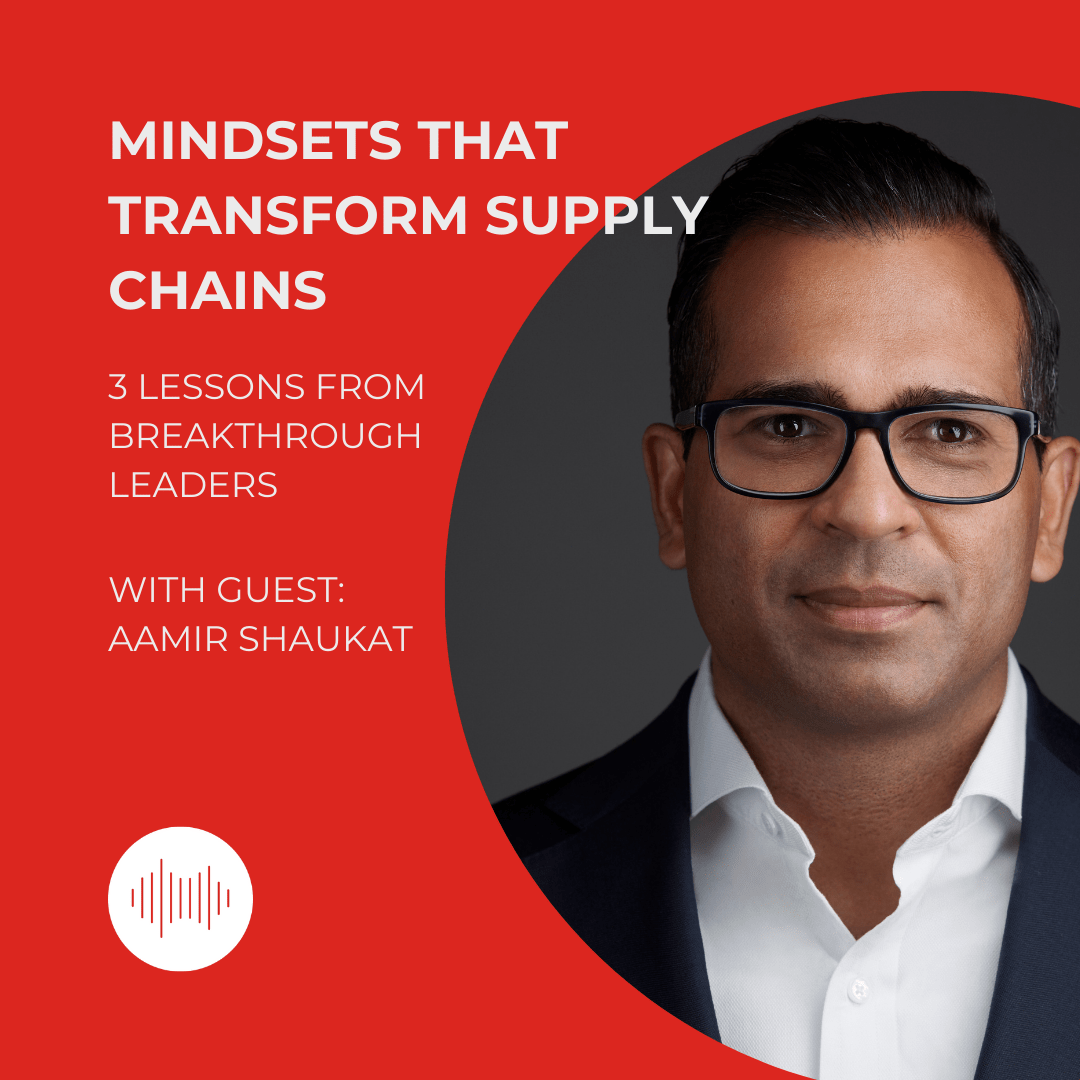
In this episode of 3 Lessons from Breakthrough Leaders, we speak with Aamir Shaukat, Chief Supply Chain Officer at Fiskars Group, to uncover his approach to innovation and leadership in the supply chain sector.
With over 20 years of global experience in consumer goods and medical devices, Aamir has led transformative initiatives at industry giants like EssilorLuxottica, JDE Peet’s, and Mars. His journey highlights the importance of adaptability, vision, and leveraging challenges as opportunities for growth.
What Will You Learn?
Find out more about Aamir Shaukat here: https://dk.linkedin.com/in/aamirshaukat
Lessons:
Building Resilience in Disruptive Times
Driving Transformation as a Leader
Personal Growth is the Key
If you like this episode, you’ll also like…
Mindset for Innovation with Dr Tim Moore
Welcome to our sixth podcast episode! Do...
Own Your Approach with Philippe Schaillee
How does failure drive growth and innovation...

Why is Personal Development Important? With Elizabeth Uviebinené
Welcome to the first episode of Series...
Zannah Ryabchuk
Hi and welcome back to 3 Lessons from Breakthrough Leaders with me Zannah Ryabchuk, CEO of Breakthrough Global, I’m here again with Dr Bart Sayle.
Bart Sayle
Hello everyone.
Zannah Ryabchuk
And this podcast is all about giving you insider tips and the know how from the world’s foremost leaders and creative talents, distilling their knowledge and experience into three lessons, which we guarantee will help you and your companies to unleash your potential. Okay, so today, we’re absolutely delighted to welcome Aamir Shaukat. Aamir is a senior procurement and supply chain executive with over 20 years of global experience in the consumer goods and medical devices sector. As Chief Supply Chain Officer at Fiskars Group. He heads transformative initiatives backed by previous leadership roles at EssilorLuxottica, JDE Peets and Mars. And of course, it’s from JDE Peets that we know you. So we’ve really, really been looking forward to having this conversation today, mainly because the world’s gone mad for the last few years, and I don’t think anyone has been hit as hard as a supply chain. So I’m really excited to hear about your perspective on, first of all, the last few years, and the disruption that you faced, and how you’ve all managed to not just survive, but in many cases, thrive through it.
Aamir Shaukat
Well, thanks. Thanks for having me on this podcast. It’s a pleasure coming here and talking supply chain. And Zannah, as you mentioned, we in supply chain, we always knew supply chain is important. I think that in the last few years, supply chain really came, you know, at the center stage during all, some of the crisis we face, whether it was pandemic or high inflation or even, you know, the semiconductor shortages. And I believe that there may be another one around the corner after the outcome of the US election results. And I think that in the past 2030, years, we always faced this kind of challenges before. But I think what, what is changing now that these kind of disruptions are coming now quite often and much faster, and I think that’s what’s pushing supply chain to its edge. But I believe that is a great opportunity for supply chain professionals to be, you know, at the forefront, and being even present at the boardroom. Supply chain is certainly at the CEO’s agenda.
Bart Sayle
Well, one thing I’ve noticed is that supply chain, in the past, I can remember working in the corporate environment when it wasn’t called supply chain. It was called a whole number of different things that eventually linked together, and then supply chain came in. And now ordinary people start to talk about supply chain. I think what happened with COVID and shortages and so on. It sort of went into the public consciousness, even if they don’t understand the detail or the intricacies they now have the concept of supply chain. So it’s stretching into everybody’s life.
Aamir Shaukat
Yeah, we sometimes, you know, there’s a, there’s a little joke among the supply chain professional where you say that, ‘Oh, you lost a football game. Oh, you can blame supply chain for that,.’ Right? So you can blame anything now for, for supply chain, basically. But you’re right. I think that I see as a positive, even though that the trigger is lot of disruption and very volatile environment. Also, I think the geopolitical tension is also rising, and that also putting supply chain, again, into the forefront. But again, this is, this is great opportunity, because I believe that besides the CEO and maybe CFO, head of supply chains, they are the only one who have really end to end view of the business. And that’s a great position to be in, because then you really know what is, what is happening throughout the business.
Bart Sayle
Lesson One: Building Resilience in Disruptive Times.
Zannah Ryabchuk
So you’ve mentioned it already. There’s going to be ongoing disruption. It’s coming faster. It’s coming thicker. How on earth do you manage to then project how to be even more resilient to disruption? So what are some of the things that you would recommend?
Aamir Shaukat
That’s a great question. And recently, by the way, I heard one of the podcasts with Philippe Schaillee right when we were working together. He’s been, you know, a great, inspiring leader. I carefully listened to his podcast, and he was talking about, right, and you know, in JDE culture was about playbooks, and you sort of develop your playbook, right? And, of course, over this, some of the transformations I have done across different companies, you create also sort of your playbook when you come to the new environment, how you go about it, right? So, and for me, is always about first creating the division and setting the ambition. And you do it first by understanding where are your pain points, where your point of departure and where you want to go to but then it comes down to you have to build a great team who have the right capability, and not just functional capability, but the right mindset, right attitude, which can help you to bring that ambition alive. In order for us in supply chain to be really resilient, you have to do two things. Of course, you’re looking at is your supply chain resilient enough? And building resilience in supply chain comes with a cost, right? Because, of course, you can say, instead of one factory, I can have three factories, but this is going to cost you crazy amount of money, right? So how you’re going to balance this, taking the right decisions, I think, is important. And the other thing is, how you build or have a resilient team with the right attitude and mindset. And I think COVID told us you can’t do monthly, weekly S&OP meetings and cycles and so on. You are talking daily. You are talking every few hours, and I think you need the team who can then react to those situations in the right way.
Zannah Ryabchuk
And can I ask, How important do you see mindset? Because you’re talking about you know, you need to have those structures in place. We need to have the method, but in your experience and from the successful transformations and maybe the less successful ones that you’ve been involved in, where did mindset play the biggest part?
Aamir Shaukat
One thing is right, that what I’ve seen it the people and the team were not lacking ideas or plans, but they were just, you know, aspirational ideas, but lacking very disciplined execution. And I think this is where then the mindset comes in place. If you see some challenges along the way, which always come so, so you have to have the right mindset to say that, okay, how do you find other ways to get to your goals? You don’t, you don’t forget your goal, but you find other ways, and you mobilise your energy to achieve that what you were intending to. And this is where the mindset comes. And to be honest, when I’m also building team, recruiting externally or internally, I spend maybe 10-15% of my time checking and interviewing them about their functional capability or knowledge. I’m probing them a lot about their passion and about their mindset and about hungerness to drive things, because that’s difficult to train and teach, at least based on my experience.
Zannah Ryabchuk
So everybody is finding, and has found over the last few years, and will continue to find that disruption, uncertainty, volatility, will just keep being on the agenda, and it’s very hard to predict how things are going to turn out, but what we can be sure of and what we can prepare ourselves for is how we respond to those challenges. So at Breakthrough certainly, our take on this is that, you know the technology is going to change, maybe the political or economic situation is going to change, but what you’ve got control over is the way that you think about it, and the mindset that you’re building for yourselves and for your teams in your organisation. And, of course, the culture that you’re shaping to make you resilient to this, so that people are aware that things are going to be uncertain. People are certain of that fact. They’re more comfortable being uncomfortable. They’re agile, they’re flexible, they’re used to the fact that things might change at a moment’s notice, and actually they’re ready to rise to that challenge. So for us, making sure that you’re actively, as a leader, focusing on that mindset piece is critical to resilience in disruptive times.
Bart Sayle
And that stood out for me with Amir when he said that now more than ever, he’s recruiting people, not just for their competency and intellectual abilities, but also for the mindset and their attitude. In effect, their emotional management, as well as everything else. And the other thing that stood out was when he said that, gone are the days where you have your weekly S&OP meeting or your monthly S&OP meeting. You have to be these days in constant communication, because things are changing so fast.
Bart Sayle
Lesson Two: Driving Transformation as a Leader.
Aamir Shaukat
When it comes to leading transformations, especially if we look at in the context of supply chain transformation, if you make it a very functional transformation, it’s going to fail or it’s not going to work very well. A great ;eader I met a couple couple years ago, he told me that it’s only going to work that you have to make it as a business transformation. And that was the so powerful piece of advice. And since then, I have been leading successful transformations. These are, these are very simple things, but if you follow that, it really helps you to make an impact in the right way.
Bart Sayle
And if you remember, in Breakthrough, we’ve always used a distinction between transformation and change. That actually there’s lots of change going on. And there’s lots of projects that actually set out to change things, but they never get far enough for transformation, because what they do is they change a little, and then they change back. And you need to hit a point where you don’t change back, you’re now in a different place. And I like the idea that you enlarged functional transformation to actually, it’s all about business transformation. I presume you’ve had experience of, in your career, of being on change projects which haven’t actually got to the point of transformation. So I’m wondering, what do you think is key to actually get that point of transformation where you don’t go back,
Aamir Shaukat
I would say three things. One is, one is, I believe that always come as a leader, that you need to paint this vision and purpose. This is important. And sometimes I even say that this transformational journey never ends. And I tell my team that enjoy that journey, you know, and I always take from sports to say, right? You can’t say that, ‘Okay, that was a great year. We won the Premier League and so on.’ But next is another, another year, and, you know, so you have to move from game to game. It’s important. So I think having that clear vision where we’re heading towards, I think it’s important, because otherwise you would say there’s a risk of going back and it’s important that you keep progressing. Second is, I think that transformation requires, sometimes tough leadership as well. That you don’t let things get slip also. It’s also important that if you feel like that things are slipping, you have to then intervene as a leader, to say, ‘No, we are not going back.’ Or sometimes it’s also fine as a leader also to accept that, no, we did a wrong choice, and we accept that mistake, and then it’s okay to go back or go to to the next step. And also, I would not say that you just say, ‘Oh no, this way, or this the only way.’ I think we should be able to adapt as well, and I think that’s also important. But that adaptation should lead to your towards towards your vision. So you’re basically course correcting a little bit if it’s needed, but make sure that you are moving towards your bigger, bigger vision.
Zannah Ryabchuk
So we’ve talked very much about the disruption in the supply chain and the current landscape. Some of your leadership lessons. I’m interested now to hear a little bit about something you’ve already touched on there, this idea of being the supply chain leader, but needing to have a bigger picture. Needing to have maybe that seat at the table, but also understanding how your role, how this function, interacts so inextricably with everything else that’s going on, and that you can’t just have the supply chain hat on. You’ve really got to be thinking big picture all the time, haven’t you? So I’d love to hear a bit more about that.
Aamir Shaukat
No, I’m very fortunate now with this, and by the way, also, you know, I’ve recently made that step change in my career right to taking that role of being responsible for overall supply chain. And even not updated yet on my LinkedIn, that even for the Fiskars Group, I will be taking over the group sustainability role as well. So
Zannah Ryabchuk
Congratulations. Fantastic.
Bart Sayle
Congratulations.
Aamir Shaukat
Thank you. And I believe that you know it links so well because also, even when it comes to sustainability, right, 70, 80% of the execution happening anyway in the operations and supply chain. So it’s very well linked. And we’re really looking forward to further shape a group strategy on sustainability. So I’ve been fortunate now to be part of the executive leadership of the group, and of course, I’m also going through my learnings and how to be part of this executive team. And one of the key part is also in order to be successful for your or for my supply chain transformation is the peer alignment with my peers, right? I think it’s very important, and it comes only in a way that that I understand also their needs. And I also have the view to say that what are we as a collective group aiming to achieve for the business, and you have to be, you know, in the collaborative mindset with the CFO or with the head of the businesses that is not about that I can have a great supply chain projects if they are not helping the business. And that’s sometimes even my team also doesn’t like it, because they say, ‘Oh no, no, that’s something we have to do it. This is great.’ But let’s also use the narrative, the right narrative that okay, how this is going to help the business. So I think this is important to make that link and work collaboratively with the executive teams to make sure that we are doing the right things for the business.
Bart Sayle
So I liked that for Aamir, a key part of transformation, for someone leading transformation is to have a very clear vision of where you want to go and a purpose behind that, but being able to really translate that for the people that work for you, and people in your team, the wider company, and have that as the fixed point as you move forward. He also mentioned that intentionality was very important to keep you on the track, but not to the extent that if you find that you’re not going in the right direction, you can’t shift and change your course. And then, as a leader in supply chain, you’re also looking much wider than supply chain. You need to keep the business viewpoint in mind all the time. He sees that you need a much wider business viewpoint of what the business is doing, where the business is going, and how supply chain can actually drive that. And instilling that in your leadership team at least, so that they have that business perspective.
Bart Sayle
Lesson Three: Personal Growth is the Key.
Aamir Shaukat
Well, my journey, you know, started 20+ years ago. I actually was studying industrial engineering, but already one of the professor at the end of my study who inspired me about supply chain, because actually during my studies, I was doing marketing internships and and so on. Then he was a very inspiring professor who started talk supply chain and, and I was very intentionally looking for a kind of supply chain graduate programme, and I landed with one of a great company, Beiersdorf in Germany, who manufactures, you know, great cosmetic products. And then, already, from the beginning, it enabled me to go through different parts of the business. I was saying that supply chain enables you to really end to end. So I was able to, you know, work in different parts of the business. And really that gave me a lot of lot of perspective from from the beginning, I believe that the other key part of my career, and also my journey along supply chain, has been that I was able to work for some, some really great businesses, but also in the different parts of the world. So I’ve spent time working in Asia for almost eight years. I worked in Europe, of course, and that has really, I believe that gives you really perspective and you see different best practices. And which enables you to use your, you know, develop your own playbook, as I was saying, and then deploy it in different conditions. And of course, I have learned along that journey. I made some mistakes, and I’ve learned through that mistake, and if I will pick one example, is like when one of my first experience of leading a team. I was sent from Germany to Thailand, and I came with the mindset, you know, from the very from a very corporate culture to a very local, regional team in Thailand. Which is very different context, you know, very indirect culture. And. And I say, Oh, you have to do this, and you have to do that, and I have all the answers, but I saw that the team was not reacting at all, because I was just telling them what to do. And even I scared them a lot. Until somebody took me on the side, and it was one of my mentor as well, and he said that, ‘Hey, you are in a different different culture and different contexts, and you have to do things differently.’ And there I learned, you know, the power of building relationship, also with your team, and especially in the Indonesian Asian culture, spending time with your team and understanding their needs. And so again, this is just an example that helped me to, you can’t apply the same way you can manage teams, for example. Or even now, along the last 20 years, I have learned that right, even in my leadership teams, which I love to have diverse team. And diverse means not just from, you know, gender or background, but I love, like to have diversity from character standpoint as well. So I’m sometimes I like, I need some tough characters also in my team, which is challenging, but, you know, you have to balance it. What I learned is that I can’t force them to learn my way of doing things. That’s one of the difficult lesson I learned that I just need to also let go sometimes. what matters is that we agree on what results they need to deliver, and I let them also figure out that how they’re delivering them.
Zannah Ryabchuk
What were some of the things that you know in that moment where you know you’re going to get that, that new role, you’re feeling super heroic. The world’s at your feet. Everything’s very exciting. Your career is built to this point, but then there must be some apprehension as well, of ‘Oh my goodness, what are we going to do now?’ So what was that experience like for you? And what can some of your learnings in that transition I’m interested in.
Aamir Shaukat
Of course, along your career, when you progress, you make certain those transitions, right? And I’ve been very fortunate that along those transitions, this is where the mentorship and your network, your powerful network, can help you and guide you. So of course, the moment I knew that that I’m going to take this role, of course, I reach out to some people to say that, ‘Hey, you have done it before and how should I do, what should I be careful?’ So of course, I think this is what I also did. Got some some advice and and then, of course, you prepare to say, okay, you know what’s your first 90 days going to look like, and how you structure those kind of things. But at the end, I think it’s important that just go with the right mindset to say, ‘Okay, this is great learning experience, and it’s going to be and I’m very fortunate that I have the right boss, you know, who took that decision and is very supportive in that context.’ And so I think, yeah, having the right support, right onboarding programme, that’s also important that if you’re transitioning to new role. And that’s also responsibility of the leaders, that right if you’re bringing someone into completely different setup and role, make sure that you have the right onboarding program.me And this is what I was provided with internally, externally, and that really helped me to, you know, to hit the ground running.
Bart Sayle
So I like what you said about the importance of mentors, and you’re a mentor yourself. So from our listeners, there are young people who are just entering their career, maybe in supply chain, maybe not. But what sort of advice would you give to them?
Aamir Shaukat
I think it’s important to get different experiences, especially in the early careers, right? Because I think it’s important that to build good perspective of the things and I was offered along the way, I either offered or I saw opportunities. And now how I try to read it, to say, Okay, how this opportunities, what critical experience is it going to provide? So for example, Is it a people leadership Is I’m going to get out of this role? To okay, I work now in a headquarter, maybe this role is more giving me experience of working in a subsidiary, an affiliate in a different country, for example, or I’m going to do a project role. So I think along the way, I’ve been kind of trying to collect different critical experiences and that has built my skill set to say that, okay, I have done this and I have done that, okay, maybe this role is going to offer me some another, another critical skill set. So I think that would be a piece of advice that, you know, get different roles, get different you know, and learn. And often, people are always talking about promotions. I never used to thought about just promotions. For me again is I’ve been always about new skill set and what, how I’m learning and growing. And this could be. Also in certain lateral steps as well. It doesn’t need to be always a career ladder towards promotion. So I think that’s also important to gain different experience and learn along the way.
Bart Sayle
What I liked is when Amir said that for him, growth was the key, and that growth is not necessarily promotion. So obviously he has been promoted to very senior roles, but that’s not been key for him. What’s been key is the personal growth leading to that, and to do that, he’s used a variety of great techniques, I think, and one of them is to seek out opportunities, whether that’s in a new country, whether it’s a new company, whether it’s a new part of the organisation.
Zannah Ryabchuk
And what he’s also done is build a network, and what sounds like a fantastic network of really great mentors that he can trust. And we’re such huge fans of mentorship at Breakthrough. So it’s not only beneficial, of course, for the mentee, but the mentor gets an opportunity for growth in that situation as well. So if you don’t have a mentor, or you haven’t been a mentor, really consider getting involved in some way. Reaching out to somebody and making that connection, because it will stand you in fantastic stead as you move through your career journey. All right, so this is the part of the show where we’re going to ask you your Hot Seat questions. Are you ready?
Aamir Shaukat
Yes, let’s give a try. Yes.
Zannah Ryabchuk
What’s the most exciting thing you’ve ever done?
Aamir Shaukat
I believe most exciting and courageous thing I did that when I was 19 years old, that I decided to to go to Germany to study in German language without being able to speak a word of German, exciting.
Zannah Ryabchuk
And terrifying in equal measure.
Aamir Shaukat
Yes.
Bart Sayle
Well done. Did you do it?
Aamir Shaukat
Yes, I did it. Of course. I first learned the language, then I studied. But, but I did, I did learn pretty quickly. Yes.
Zannah Ryabchuk
What inspires you in life?
Aamir Shaukat
I think, I would say there are many or different sources of inspiration. For me, it’s, can bemy my faith, my family, even could be nature, if I’m hiking or running, but also, you know, some mentors, some colleagues, some friends. So I would not say single out one thing I think is, can be different, inspiration,
Zannah Ryabchuk
What brings you energy and motivation in your everyday life?
Aamir Shaukat
I would say two things. One is, I always, you know, want to make progress, keep moving forward. So able to that I’m I’m doing what I like to do that gives me, gives me motivation and energy, . And second that fortunately I have ability to to support and help people, whether it is my family or friends or or my network, that I’m able to help them.
Zannah Ryabchuk
Well, it’s been fantastic having you. So thank you so much for sharing your time, sharing your expertise, sharing your experiences with us. We never take it for granted. We feel it’s a real privilege to have been able to listen and learn from you. So thank you so much.
Aamir Shaukat
Thank you. It’s been a ride now since one, one and a half year, but I’m enjoying it. That’s what I’m telling a lot.
Bart Sayle
We can see that.
Aamir Shaukat
That I’m really, yeah.
Zannah Ryabchuk
That’s the best thing. That’s the best thing.
Zannah Ryabchuk
So thanks again for joining us. Remember to hit the subscribe button and join us again for our next set of lessons. And if you’ve got any questions or comments, email us at bartsayle@breakthroughglobal.
Bart Sayle
We’d love to hear your own leadership stories, and we’d also love for you to share this episode on your own social media and review and rate this podcast on your player of choice.
Zannah Ryabchuk
Thanks to our production team, Julia Soltysova at Breakthrough Global and Robin LeeBurn at Fairly Media. And of course, thank you for listening.
Welcome to our sixth podcast episode! Do you want to learn what it takes to maintain an...
Welcome to our fifth podcast episode and the first one in 2022! We start the new year...
Listen to our new podcast episode where we explore the power of playbook culture from accomplished CEO...