



Mindsets That Transform Supply Chains with Aamir Shaukat
How is innovation reshaping the supply chain...
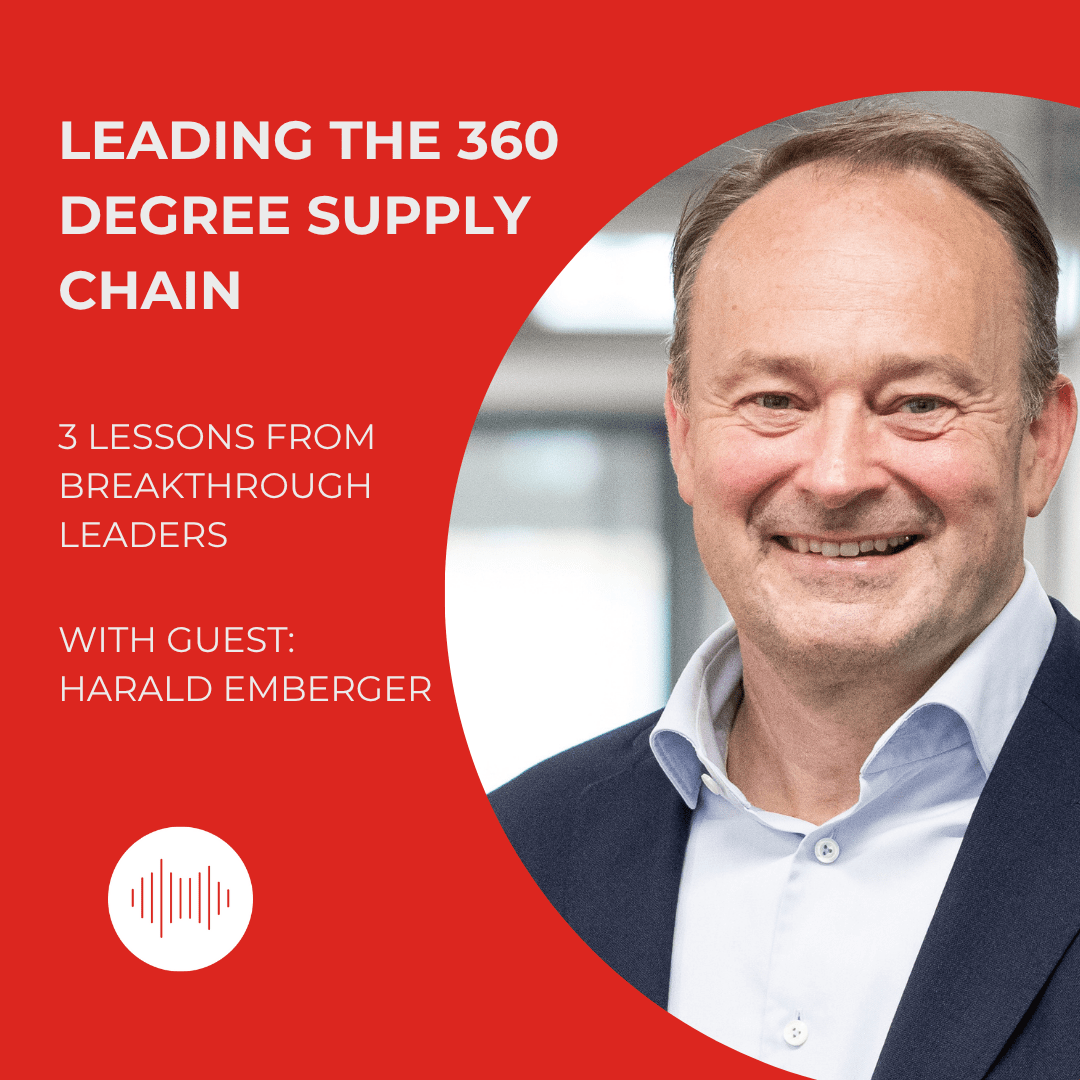
In our latest 3 Lessons from Breakthrough Leaders podcast episode, we’re joined by Harald Emberger, Chief Supply Officer at Reckitt, to uncover his 3 powerful lessons for building future-ready, resilient supply chains.
With global oversight of Reckitt’s end-to-end supply chain, procurement, and sustainability strategy, Harald shares his deep expertise on using supply as a competitive advantage – and how organisations can future-proof their operations by embracing agility, leadership and innovation.
Harald brings a wealth of experience from leading high-performing teams at Beiersdorf, Unilever and Mars, with a career that has taken him across five countries and cultures. In this episode, he shares what it takes to lead through complexity while staying anchored in purpose.
In this episode, we explore 3 lessons with Harald:
1. Supply Chain as a Competitive Edge
2. Do You Have 360-Degree Leadership?
3. The Future for Supply Chain
This podcast brings you genuine, inspiring conversations with extraordinary leaders – many of them Breakthrough alumni – who are proving that business can be a force for good. Created with purpose, not profit, it’s designed to spark fresh insights and help leaders at all stages make an impact.
Find out more about Harald here: https://uk.linkedin.com/in/harald-emberger-8604a98
Lessons:
Supply Chain as a Competitive Edge
Do You Have 360-Degree Leadership?
The Future for Supply Chain
If you like this episode, you’ll also like…
Mindsets That Transform Supply Chains with Aamir Shaukat
How is innovation reshaping the supply chain...

Breakthrough Leaders Unlock Potential with Gilles Morel
In our latest 3 Lessons from Breakthrough...

Holistic Leadership with Sylvie Moreau
Most leaders lead from the Head. Some...
Bart Sayle
Hello and welcome back to 3 Lessons from Breakthrough Leaders. I’m Bart Sayle, founder of Breakthrough Global. Today, I’m here with Justine Kane, Chief of Staff at Breakthrough.
Justine Kane
Hello everyone.
Bart Sayle
And this podcast is all about giving you insider tips a know-how, from the world’s foremost leaders and creative talents. Distilling their knowledge and experience into three lessons, which we guarantee will help you and your companies to unleash their potential.
Justine Kane
Harald Emberger is the chief supply officer at Reckitt. His responsibilities include global oversight of Reckitt, end-to-end supply chain, operations, procurement and global sustainability. And he brings extensive knowledge on leveraging supply as a competitive advantage by focusing on addressing resilience and agility. Harold has led high performing teams at Beiersdorf, Unilever and Mars. Throughout his career, he has lived in five different countries across the world.
Bart Sayle
It’s a great opportunity to have you on the podcast, Harald and thank you for agreeing to this.
Harald Emberger
Thank you, Bart.
Bart Sayle
I know that you’ve had an incredible journey in leadership and also supply chain leadership. What stood out for you in this journey?
Bart Sayle
I picked my journey out of passion and love for this role, the passion for supply chain, the passion to create value, to work with people, and the doubts are always when you lose the fun factor. So I think in these roles, as in many leadership roles, you need to truly enjoy and love what you’re doing every day. And that was always guiding me throughout my career and throughout the various companies I had the chance to work with.
Bart Sayle
Lesson One: Supply Chain as a Competitive Edge.
Bart Sayle
Harald you’ve always seen supply chain as an important and valuable contribution. That wasn’t always so for everybody, but I think that what I’ve seen, and particularly recently, is now supply chain is on everybody’s lips. You hear people, you hear consumers talking about supply chain. I think maybe that came to the fore during COVID, but now it’s absolutely in the front line. How have you seen that develop?
Harald Emberger
A wise person told me long, long, long time ago is that there are two things you need to know in business, is how to sell it and how to make it, and when you do both perfectly well, that you will strive. But more on the serious side, for me, it’s important that the brands you build with the assets you have, and you use your assets to build your brands. So to be in charge of your own supply chain means as well to be in charge of your destiny, of the quality of the product, of the agility and probably most importantly, on the innovation side, and as well on the people side. Now if you think many, many years forward, when most of the fulfilment will be done through digital channels, social commerce, ecom. A lot will be supply chain, and at the end, the online sales tool. And therefore, I believe that the importance of the supply chain, not only to be a competitive edge in resilience, but as well, to be a competitive edge on the front end, on the agility, will be a crucial factor to the business overall. An end to end supply chain carries a lot. It carries the quality. It carries the purchasing, the procurement side. Carries the conversion, logistics and then obviously all the go to market capabilities. So a supply chain itself, a modern supply chain, an integrated supply chain, is a seamless integration of many, many functions and people, and the skill of us is to bring those together in the most efficient way and make them work as best possible together in a competitive way. And I think that’s as well the fascination of supply chain and coming back, I truly believe that a well oiled supply chain is a competitive edge to a business and, in our case, towards a brand.
Bart Sayle
Yeah, and I remember you saying Harald in our briefing call that for the most part. Supply chain is invisible until something goes wrong.
Harald Emberger
I would like to turn this, I think, and this is what’s changing in the past. It was, but obviously, a couple of things have happened, which I think are changing. I think the first thing is the thinking about supply chain. It’s not a cost centre. It is a value generator. So, and I think that’s the lens, and the role the supply chain is. It needs to create value for the business, either by better product, better service, outpacing your competition, or others other measures. I think that’s the that’s the role of the supply chain, and that’s how we can create value. It’s not a cost centre, of course, usually 2/3 of the costs are within the supply chain, and a lot of responsibility lies in supply chain. As you said, if it goes well, okay, if it doesn’t go well, big issue. But here I see generally, with the support of all the digital capabilities supply chain changing in the businesses. They’re becoming more and more a value generator, leveraged to be either faster, more agile, more resilient. So they’re becoming more and more a business factor, and are having a seat at the table.
Bart Sayle
And I like the way that you’re reframing some of our thoughts and so on, on supply chain, and turning them around, and if you like, bursting some of the myths about it. But do you still find a lot of misperceptions about supply chain, and I’m particularly thinking about within a company And within other functions.
Harald Emberger
I think strategically, my learning is that the end, if you bring the end to end, value creation as close as possible together, it’s the most competitive setup of a supply chain. And this is sometimes a misperception you have, that you leave certain part of the organisation bespoke or in different setups. Of course, there are industries where you do this, and it makes a lot of sense for our business. Fast moving consumer goods, as closer you bring the supply chain together, the faster you are able to respond, and the better you will be integrated. The other misperception is often to say it’s a cost saving tool. It’s not, it’s, of course, a short term measure to generate savings, and it should continuously improve, and it should provide a super competitive product from a margin perspective, but when you run the funnel, the supply chain, through a saving perspective, you start to starve it. So the supply chain is something which, the way I look at it, needs to continuously improve, but needs investment as well, whether it’s in people, in infrastructure, in assets, in logistics and in systems and digital so and sustainability, obviously, so to have the return on assets. So to move from a financial perspective to a return on investment return assets, that’s probably the best way to run a supply chain. I think as well Bart on this as a company, you need to be decisive whether you want a supply chain or not. There are other ways of working. You can outsource it completely. You can leave it with thirds. So I think this is the first question you need to ask yourself in a company, do I want a supply chain or not? And if yes, if yes, then how does it look like? And if no, how does it look like? Worst case is to sit in the middle, to have half in, half out. And the worst, worst thing is to say, I have it but I don’t want to feed it. I didn’t want to starve it, and that usually will run into a dead end at some point.
Bart Sayle
I thought Harald was great at reframing what supply chain is today and what it can be for your organisations. I came with a background working in companies and with companies that often supply chain is seen as a cost centre. Harold quickly corrected me on that, that actually supply chain should be seen as a value generator. So think about this for your organisation, whether you’re in supply chain or not. How can you shift your mindset from cost to value?
Bart Sayle
Lesson Two: Do You Have 360 Degree Leadership?
Justine Kane
Supply Chain is much more part of the conversation than it ever used to be, and the challenges that you face in supply chain with climate change and geopolitical issues, etc, the skill set that you need in that role as a leader seems to be far more challenged than it ever used to be. Is that what you’re experiencing?
Harald Emberger
May I describe this differently? So obviously, our jobs are quite interesting. So on one hand, you carry a, have a lot of responsibility for the business with you. You are very often in ambiguous situation, cost versus service, quality versus cost. I mean, you have always these, these challenges. You’re always in a very ambiguous situation. The third piece is that you are very transparent, so it’s 100% clear every day whether you’re performing or not. There’s no way you can talk your way out of the performance. So that makes your yourself as a leader always quite exposed, quite transparent, and you obviously need to have a leadership style which is integrative, makes you a supporter of the business, and ensure that you bring the best value to the business. Now, the career path to that is not easy, because you need a lot of resilience. You need certain capabilities to understand and to judge what is really important what is not and most importantly, how to lead your people and how to lead your team. And here, I think the skill we need to have is to develop these sort of skills, these sort of leadership skills, or, as you mentioned before, there’s constant conflict situations, maybe short term reactions. Some call it stress. Some call it resilience. How do you develop talent along those paths? So how does a career path for a supply chain, for a future supply chain leader look like? And here my learning, and maybe as well, my advice is to start very early at everybody’s career who wants to have a supply chain career and invest in a career path which builds one hand to function capabilities along the supply chain, but as well the leadership capabilities to have to manage those ambiguous situations, which when you look hindsight for many of us, the first board roles or the first exposed roles are the crunch points. Do you make it or not? And I think this is where we put more focus on this, and that’s combined with a healthy diversity, which is critical in that gives you, as well, a support structure or support organisation to to navigate through so difficult tasks. And this brings me to another part which I feel is very important our development is storytelling. We find it very difficult in supply chain, as we are very technical and usually full with data and analytics to explain these things to the business, why certain things work and why certain things don’t work. So here as well, in the development of people and is to embed, you can argue, is called storytelling, but to be able to communicate complex scenarios in a very simple, easy way, and to build and provide trust to the people around you and avoid double guessing. I think that’s that’s another element which I fear find important in this, in the skill set to have, and it’s a important journey. The market for supply chain people is quite constrained. It’s highly thought after so the competition of recruiters is high. So if you want to build your talent pace, I think the best thing you can do is invest very early in the career pathing, in the talent development, the diversity of your, of your leadership organisation.
Justine Kane
As a leader sitting on the exco, you know what, what are the challenges that you come across with your colleagues on the exco? Because there’s, there’s different commitment levels, different understanding. You know? What do you consistently see at that level are your pushbacks?
Harald Emberger
So it’s a very good point Justine. Now we all want to grow the business, and we all want to grow our brands in a profitable way, in a sustainable way. So we all have the same goals. Now, a supply chain person, maybe a finance person, sees through this lens, maybe a bit different. They look for scale, they look for efficiency, they look for complexity. The benefit of a supply setup is that you see inefficiencies in the business. You see inefficiencies in your portfolio, and you see maybe other deficiencies, easier than if you are front end market. And this is the robust challenge you have, and this is the role, for example, I play in the board, as well as to ensure that we strive in a very efficient way towards our growth targets, that we manage complexity, that we manage waste, that we manage sustainability in the most efficient way. And that’s always this healthy balance between a market-led or brand-led organisation and then the supply in the background. So you have two different lenses you look through, and then you ensure you meet in the middle. And these are very often healthy discussions you have at board level.
Bart Sayle
If we could pivot now to from the actual supply chain and its strategic role to to the people within supply chain and the leadership challenges there. Because, you know, in your career, you’ve moved around countries. You’ve managed in global settings, and you’ve got large diverse numbers of people that need to be managed and led. What are the challenges you see in today’s environment for a leader who has those issues and has those challenges?
Harald Emberger
First of all, as a supply chain leader. I think there are two lenses to look through. The first lens I would look through is you need to play with it, leadership, management and functional lead. And you need to understand when you are a servant leader, that means you turn the pyramid and you ensure that your organisation is best supported by you, and that’s true leadership. So you put the right organisation, the right people in place, make sure that the right tools to strive to engage them, you enable them and envision them. But then, on the other hand, sometimes you have situations where you are more manager, where you have to manage a task at any level in the organisation. There’s an issue, there’s a crisis, there’s something to deal with, and you act as a manager. And sometimes there’s where you are leading as a functional expert, where there is a task, you have the experience, you have a few and you go into the functional decision. But you need to be aware of that, that there are three different styles, types, and as well, you need to make sure that your organisation understands who you are at the moment. What leadership hat, what leadership hat you’re putting on. But I think this is the distinguished supply chain it is. It requires a lot of functional knowledge, and that’s why you sometimes need to play with these three aspects.
Bart Sayle
And I remember in our briefing you said something that really struck me and stood out for me was your phrase 360 degree leadership. Could you expand on that?
Harald Emberger
For us here, what we learn usually is the downwards leadership. I mean, that’s what you start with, and that’s what you at the end of the day learn first. But supply chain is a function which is an integral part of the business, like others like R D, like marketing, and so to be able to lead sideways, upwards is very important sideways, because you have to influence without authority. You have to navigate complex tasks to the organisation. You have sometimes difficult messages to bring you. Need to be able to build strong relationships with your peers, but as well, be able to go for what you believe is right and push through what you believe is right. So this sort of peer leadership is super important and then upwards. Very often in our organisation, your boss is not an expert in supply chain. It’s different to like automotive or chemical industries. In our industry, my line manager has rarely been a supply chain expert. So you need to be able to lead upwards and make sure you can explain what you’re doing in simple words. You can explain your strategy in simple words. You can engage them. You get the support, and very often that requires a lot of time, so it’s not to underestimate how important that is to make sure that you are able to lead others the support of your line manager or boss is critical in supply chain, because sometimes things go wrong, so you will have a lot of successes, but sometimes you will have failures in your in your tenure, and important that you have the full alignment and the support of your peers and line manager or boss at that time.
Bart Sayle
Harold’s experience is leading large teams across global factories, warehouses, corporate offices. And many of you have this challenge as well. So how do you ensure alignment and clarity and effectiveness with such complex ecosystems? Harold talked about 360 degree leadership as essential for him in supply chain. Where you often have to lead without direct authority, but you have to use more influence. And he saw three levels of leadership. You’re leading the people that follow you. Your leadership is also needed to communicate to your peers who you need to enrol in your plans and your visions, and then your leadership skills are required to communicate to people above you, to communicate effectively throughout all of this, Harold seizes on the ability to use stories and to use storytelling, and that isn’t making up stories, that shaping your data, your analysis, into a form that will be simple, because people listen to stories and they remember stories. And not only do they remember them, they then communicate those and the more we tell stories, the clearer they get, the simpler they get, and then they can be reproduced. And that’s a very powerful way of spreading that information throughout your organisation, throughout your ecosystem. So storytelling itself becomes a key skill for a great leader.
Bart Sayle
Lesson Three: The Future for Supply Chain.
Bart Sayle
We’re now in a world where AI is starting to be everywhere and people are some people see it as an opportunity. Lots of people see it as a threat. How do you see the future for AI in supply chain or or in business generally, but particularly in supply chain? Is this something you see as an opportunity? Is it something that has to be managed? Is it? Is this one of the risk areas that you are concerned about?
Harald Emberger
No, I’m super excited about it. I’m really, really excited about it because it enables you to do a couple of things you are not able to do before. First of all, it takes a lot of waste out of the system, because the decision basis is better, more accurate in real time. Second thing for sustainability measures, you opt the capability you have to optimise flow to precision flow to align the demand better, to synchronise your supply chain better is fantastic on the floor as well. So on the factories to have predictive machine signals, to have predictive maintenance signals to you run your factory, completely different. So overall, I’m super excited, whether it’s planning, whether it’s logistics, whether it’s process management, whenever you can use a tool which gives you a better outcome, and you don’t need hundreds of people putting stuff in is brilliant. Now the issue is that you need people to deal with that data. And I think this is one of the challenge we all have, is, how do we develop fast people who can deal with data in the factories? And these are analytical skills the same. If you have a machine, the machine stops, it gives you a message you believe it’s something different. So what are you doing with it? So our task, and I would say our big challenge as well is to develop these sort of skills in the organisation, because the systems are there, they’re available, and all many people use them. It’s, it’s just phenomenal. And I’m very excited, because it takes waste out of the system. It takes a lot of rework out of the system. It’s, it’s just easier, but you need the right people to deal with them.
Justine Kane
And do you think it will ultimately help the challenge of the balance of work-life when you’re dealing with such a diverse workforce? Do you think, do you see that happening already?
Harald Emberger
I think the ambiguity will be bigger because you have not done the work by yourself. A system has done, someone has done the work for you, and you need to decide whether that’s right or wrong. I’m not sure the ambiguity will be different, but I think it will take more stress out. Let’s say you have a crisis somewhere where the road is blocked, very simple, a road is blocked, or the container is gone, or something happened in your supply chain, the system will sort this for you. Great. However, the ways of working is different. People will communicate differently. They will communicate through systems. They will look at diagnostics. They will work differently together than in the past.
Bart Sayle
And in your mind, does that require a change in culture or an evolution of culture? Something we haven’t mentioned at the moment, but yeah.
Harald Emberger
Yes, definitely, yes. Completely different. It is less action orientated, it’s less kick and rush. It’s it’s calmer. It’s more diagnostic. It’s more predictive. Yes, it will be a different it is a different culture. And then just in coming to your work life balance, maybe this enables work life balance, yeah, but a supply chain is 24/7 I mean, unfortunately, we have things happening all the time. But I think what I can see now, having seen some really end to end, digital set setups, how people work, how they collaborate. Yes, it’s different, which is probably smoother.
Bart Sayle
And I was going to follow up, if it requires a culture change, and it requires an evolution, is there then a risk of the legacy culture resisting that?
Harald Emberger
I think it’s a culture change all the time.
Bart Sayle
I think culture is never fixed, is it, in a way.
Harald Emberger
It’s never fixed. It’s changing all the time. It’s more you need to accommodate the working environment of the talent you want to bring in, and if the talent you want to bring in, or the experts, have a different work life balance, then you need to you need to work that with them and and max that out. I think that’s what you need to be aware of. People work differently together, but as well, you have different cultures around the world, and so it’s might be different in in many regions, but I think for sure it will be different. It will be more collaborative. It’s less this heroism, if I may say that so one person running somewhere, fixing it and coming back, I think this will disappear.
Justine Kane
What inspired me in the conversation with Harold about AI was how he embraced the subject, and is super excited about how the technology is going to impact and revolutionise a lot of the ways of working and simplify human error, whilst really having Fantastic impact.
Bart Sayle
I agree, Justine. It was refreshing to see Harold really embracing this. You could see him getting excited about it, because he sees the opportunities ahead using AI and for breakthrough. This is a great example of what we call the Red Train, or the Blue Train, because we find amongst our clients, many who are seeing opportunities in this and looking for opportunities, but we also see some who see it as a threat, and if not a threat, they become resigned to it, rather than using it. And that’s the key, what meaning are you giving to AI? How are you interpreting it, and what’s the future you’re envisioning as a result of that? If you see it as a threat, you’re going to go down the Red Train route. You’re going to react defensively, or you’re going to react in a resigned way? Are you going to react cynically to it? On the other hand, if we see it as the opportunity it is, we put ourselves and our organisation on the Blue Train, and then we’re looking for ways that we can get the most out of it, the ways that we can master it, the ways we can become more efficient and effective with it, and actually it becomes, then a powerful tool for us to use to grow the organisation and to grow our people.
Justine Kane
So does this lead us onto the Hot Seat questions. I think it does okay. So Harold, brace yourself. Hot Seat Question number one, what is the most exciting thing you’ve ever done?
Harald Emberger
So the most exciting thing professionally I’ve ever done was the first factory I built at very early stage with very limited resources. And in in the Eastern European part after the war came down. So that was a phenomenal a phenomenal experience and a phenomenal task. As a person, I would say, I have the chance as a young person to travel the world a lot, and in a very unconventional way. So I enjoyed this tremendously, and still gained from that. So these are the two things I would say I still remember.
Justine Kane
Great answer, great answer, and that leads nicely on to the next question, which is, what inspires you in life?
Harald Emberger
So obviously it’s my family. So I love my family, and I get my energy out of my family, the three kids and my wife, but I’m inspired as well by creating value, making things better. I have this constant drive to improve, to get better, and that’s what’s inspiring me, and that’s maybe as well why I ended up in supply chain, and I like it so much because it’s a continuous improvement environment.
Justine Kane
I just thinking that.
Harald Emberger
But this is at the end, what inspires me is to enjoy, to do new things, to get better. That’s what keeps me going and moving.
Justine Kane
And your final question, finish this sentence, success is dot
Harald Emberger
Fun!
Justine Kane
dot, dot fun. There you go.
Harald Emberger
Success is fun.
Justine Kane
Quick and to the point.
Bart Sayle
I love that.
Justine Kane
Really great, yeah.
Bart Sayle
And we’ve enjoyed this. So thank you for that.
Justine Kane
Very much. So very much. So thank you so much for your time, Harold.
Harald Emberger
You’re welcome. Thanks for doing this. I really appreciate it. That’s really nice. And thank you so much.
Bart Sayle
Well, thank you for joining us. Remember to hit the subscribe button and join for our next set of lessons. And if you have questions or comments, email us at bartsayle@breakthroughglobal.com or connect with us on LinkedIn at Breakthrough Global.
Justine Kane
We’d love to hear your leadership stories, and we’d also love for you to share this episode on your own socials and review and rate this podcast on your player of choice.
Bart Sayle
And thank you to our production team, Julia Soltysova and Victoria Okoroafor at Breakthrough Global, and Robin LeeBurn at Fairly Media.
Justine Kane
For any business inquiries, you can reach us at contact@breakthroughglobal.com. Have a wonderful rest of the day.
In our latest 3 Lessons from Breakthrough Leaders podcast episode, we sat down with Gilles Morel, global...
How can leaders create truly inclusive and impactful workplace? Leadership today is about more than just making...
Listen to our new podcast episode where we explore the power of playbook culture from accomplished CEO...