



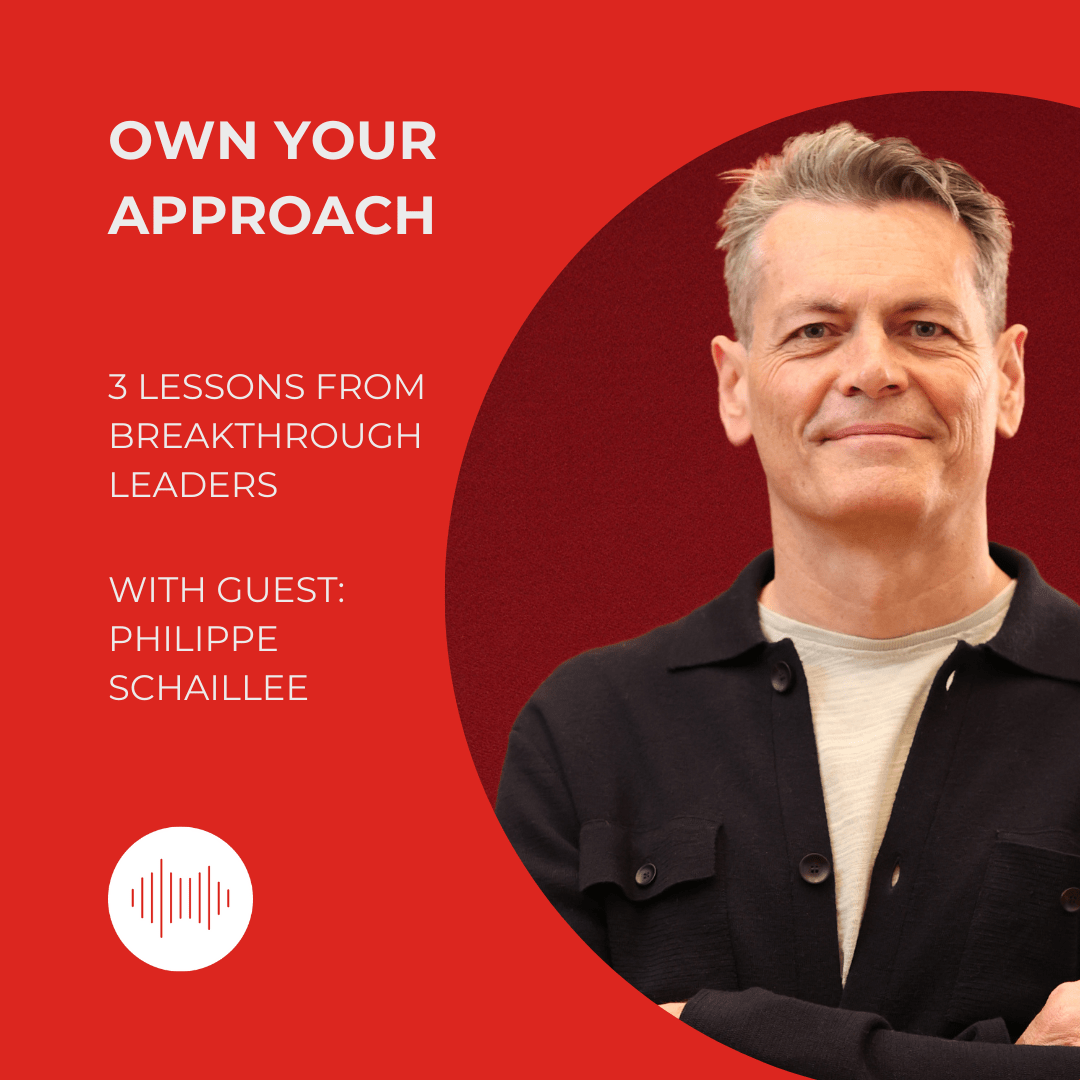
Own Your Approach with Philippe Schaillee
How does failure drive growth and innovation...
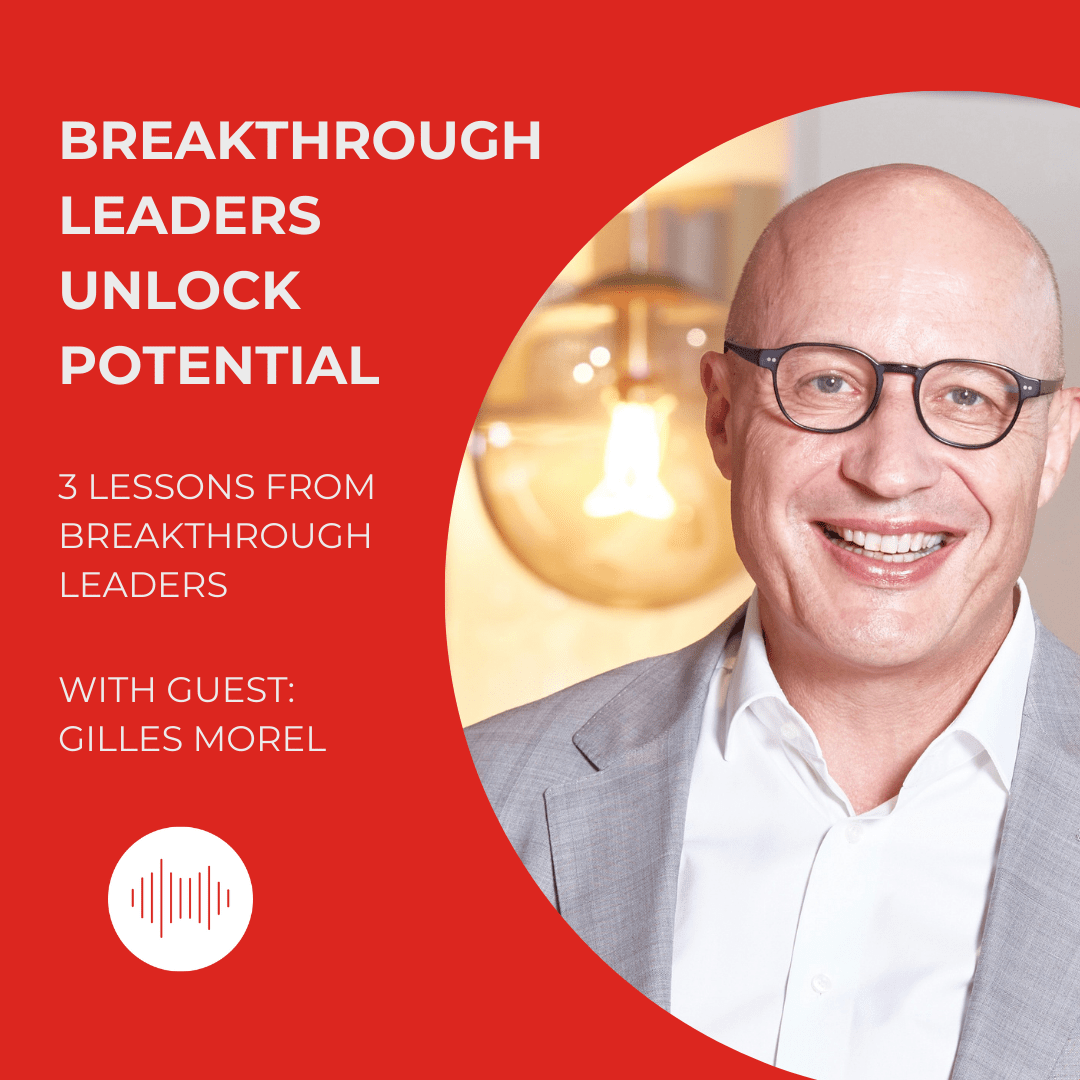
In our latest 3 Lessons from Breakthrough Leaders podcast episode, we sat down with Gilles Morel, global business leader and former EVP at Whirlpool Corporation and Regional President at Mars to uncover key strategies for leadership success.
Drawing on his experience leading strategic growth and transformation across top-tier organisations, Gilles shares powerful insights into building resilient teams, overcoming external challenges and mapping out a sustainable leadership journey.
In this episode, we explore 3 lessons with Gilles:
1. Growing an Effective Team
2. Navigating Challenges That Are Out of Your Control
3. A Map for Your Leadership Journey
This podcast brings you genuine, inspiring conversations with extraordinary leaders—many of them Breakthrough alumni—who are proving that business can be a force for good. Created with purpose, not profit, it’s designed to spark fresh insights and help leaders at all stages make an impact.
Find out more about Gilles Morel here: https://it.linkedin.com/in/gimorel
Find out more about Habitat for Humanity here: https://www.habitat.org/
Lessons:
Growing an Effective Team
Navigating Challenges That Are Out of Your Control
A Map for Your Leadership Journey
If you like this episode, you’ll also like…
Own Your Approach with Philippe Schaillee
How does failure drive growth and innovation...
Squiggly Careers with Helen Tupper
Lessons from Breakthrough Leaders: 3 key takeaways...

Business Mastery with Pierre Laubies
Listen to our new podcast episode where...
Bart Sayle
Hello and welcome back to 3 Lessons from Breakthrough Leaders. I’m Bart Sayle, the founder of Breakthrough Global. Today, I’m here with Justine Kane, our Chief of Staff at Breakthrough.
Justine Kane
Hello everyone.
Bart Sayle
And as always, this podcast is about giving you insider tips and the know how from the world’s foremost leaders and creative talents. Distilling their knowledge and experience into three lessons, which we guarantee will help you, your people and your companies to unleash their potential.
Justine Kane
Today, we’re thrilled to welcome Gilles Morel to the podcast. Gilles is a global business leader with a wealth of experience across top tier organisations. He previously served as EVP at Whirlpool Corporation and regional president at Mars, leading strategic growth and transformation initiatives. Now he leverages his expertise as a board member, strategic advisor, investor and mentor.
Bart Sayle
Welcome Gilles.
Gilles Morel
Hello, Bart.
Bart Sayle
This is really great for me, because we go back several years and and it’s wonderful now after that time to see you again. How I’d like to start off is if you could give us an overview of your leadership journey.
Gilles Morel
Yes. Bart, so thanks a lot for the opportunity. I have great memories of the time where we had together, and that had been part of my leadership journey. I started as a graduate trainee, but rapidly I embarked on global and international career, because that was embracing both aspects of the business and the people. That’s what drove me and I had this role, and I love it.
Bart Sayle
Lesson One: Growing an Effective Team.
Gilles Morel
Back 15 years ago, 16 years ago, I was becoming the leader of such general managers. And same thing the kickoff really, where your team Bart and you personally helped equip me with different tools to make a difference as a leader. For the last 10 years, I’ve very consciously organised my time, 50% on growing a better business, and 50% on growing people, talent teams, and this include myself as well. So this, and this was they’ve been reflecting on, on my agenda, on my routine, on my meetings, on all of this. This, this purpose is still there, and my commitment to people is there. So as a non executive, as a mentor and coach, I’m investing in this. I want to keep doing this and helping others to build effective teams and keep bringing light in in the soul of people and teams.
Bart Sayle
That’s so inspiring, that phrase. Bringing light into the soul of people.
Justine Kane
It really is. Really is.
Bart Sayle
wonderful.
Gilles Morel
I also believe that one is critical building a effective team is in aftercare, is in everyday and needs be embedded in everyday routine of leadership team. Because otherwise this, this is going to disappear. You’ll get everyone pumped up with great emotion, but this vision, this team purpose, the protocol you decide, the tools you have maybe tested in this kind of event, you need to bring them to life in every day. And that’s why I do believe it needs to be reflected in routines. It need to be reflected in your protocol, in the language of a business, of a team.
Justine Kane
That makes so much sense Gilles. And it’s really interesting how you, you know, your protocol of each of the different places that you’ve gone to that you’ve kind of rolled it out. I guess it’d be interesting to understand a little bit about the Breakthrough Tools that you’ve used, or the tools that you have used that have been really useful in that, in that process.
Gilles Morel
So yes, I think you in your other podcast, you talk a lot about playbooks and strategy and this. I do believe there are playbooks as well for team effectiveness, for engagement. And maybe they are not as popular. We don’t have the other big consulting company. They are more boutique or this, but I think we have playbook for team engagement, and some of the tools are absolutely critical. So personally, I’ve embedded in all my business the Breakthrough Feedback Framework. I find it very, very effective. What is working, what’s not working yet, what is missing, what is possible. Because it’s enabled everyone to be heard. It enables everyone to commit afterwards as well. It creates space. It’s very effective because you have to give your two three most critical inputs you believe, you trust, the collective intelligence of the team. And it opens possibilities. I’ve also, you know, some of the language on the tool of Power Time, the language of the Passenger in an effective team. I also, one, one tool that I found, and it’s not always very easy to to execute. That this one is not Breakthrough, but in my team, leadership team, Mars Chocolate, I had, let’s call her Amanda. She was not HR, but she was procurement, but she was a passionate facilitator. So, you know, that’s also in the team. Everyone played different role, independently of the function. And she trained us on the 3 – 5, and I found it very powerful. Four and five, you know, it’s for decision making. 4 – 5, on the line, move on. 3, you have to say, why you are on three and what you need to get to a 4 to a 5. If you are 0, no go. One and two. It’s not enough to say you disagree. You need to come with a contact proposal. I find it very effective. All the things as well I’ve put in place. And you know, when Bart did an event, there was never a pre read.
Bart Sayle
So one thing that occurs to me when you say that is that if we look at other areas, such as the military or athletics or even performance, such as, you know, ballet and theatre and so on. So much time is spent rehearsal. It’s rehearsal and it’s practice and so on. Whereas in business, teams are just, they’re on the court all the time. They have very little time for rehearsal. They’re always performing, in a sense. So the idea that you you can just do a one off session, and then your team is effective. That just doesn’t work. Your team needs to be reignited, regenerated, energised, constantly.
Gilles Morel
No, I absolutely agree. And very often we delegate this, this warm up to consultants, and that’s wrong. It must be owned by the team. That’s why the check-in is important. That’s why you know the protocol of the team when you have you know having each other’s back in a team is absolutely critical, and it’s a practice of every single day.
Bart Sayle
I really like Gilles approach, where he spends 50% of his time on growing the business and 50% of his time on growing the people. That’s a far greater percentage than than I’ve met in the past. And you can see from his results that it works. He also said that as a leader, he embeds team effectiveness into the daily operations through practices such as the Breakthrough Feedback Frame and specific sessions where they work solely on the team effectiveness. So these tools ensure that time is not wasted. that meetings and interactions are focused. Decisions are well informed, and teams remain aligned and engaged. Time is well spent. Time is not wasted.
Justine Kane
Yes, that’s a super interesting part of what Gilles was commenting on, and I loved how he reverts to playbooks. And by using this approach, it really supports all learning styles. You know, kinesthetic learning, visual, auditory. Which means that it’s bringing out the best in your teams, and it works for everyone’s different styles.
Bart Sayle
So as a leader, ask yourself: What am I prioritising in building and growing my team’s effectiveness and what tools am I using? What tools am I not using that I could now put into action? And the best way is to just start and start small and just keep monitoring it, and then add more and more.
Bart Sayle
Lesson Two: Navigating Challenges that are Out of Your Control.
Justine Kane
What with the best intentions, things just don’t always work out, do they? So I think it would be interesting to hear some stories that you might have that are reflective of that.
Gilles Morel
Well, when I joined Whirlpool six years ago, it was after painful integration of two European businesses, and I was in charge of making a turn around. And yes, it has been very, very hard, but after 18 months, two years, we regained scale and were on the path of profitable growth. I had done the kickoff event, and that was great. Then we had to navigate through COVID. And through COVID, we kept protocols of team effectiveness, we kept contracting. We did it virtually, but we kept this, this discipline. And then came the war in Ukraine, and the sanction on Russia, and the fact that, yes, in when you sell washing machine, you have to buy steel. You have to buy electronics. You have to buy plastics. And as a US based company, and with European leaders, and, you know, executive, happily, I realised that we had to exit and we exited Russia. We sold the business, and that created a change, because the profitable path for growth with Russia that was a significant one of the core priority market in terms of top line, but also a key contributor, changed the game completely. And this at the time of very high cost inflation on energy, on steel and so on.
So the path has changed, and we did what is called a strategic review. I had to propose to the board a different continuation scenario, and we had to consider other option for ownership of this business. And yes, the vision, the you know, was a bit clouded when your business, let’s call it as it was, is potentially for sale. How you engage the team and when you don’t have all the answers on the what. Because you know you on your organisation, yes, you keep focus on your brand, on your innovation and this, but you know you don’t know which flag or logo will be on the top of the building in 18 months from now. There is one thing you can own you can always own, is the how. Is how you do business. That’s why with my team we decided to keep and double the effort. Yes, I was at this moment, I attended an event with a leader, Nathalie you worked with her as well in the different contexts.
Bart Sayle
Nathalie Roos, yeah.
Gilles Morel
With Natalie Ross, yeah. And with somebody worked on the concept of a mission impossible. And I said, Well, you know, it resonated very much. We embarked and we articulated what is at stake for us. What is our mission impossible? We Renam it, our mission im possible, not impossible. I’m possible. And we focus very much on, you know, what is success looks like for our people, our organisation. We also say that at the end of the day, yes, we want to be the best place to invest for our shareholder. So yes, okay, we are for sale. The one who will buy us with the one who will be the most interested, or the one, and that was our responsibility. So this time, despite the clouds of the strategic review, focus on making sure that people didn’t forget that what matters. We were there towards the life of the consumer, independently of the flag on the building. We were there to be an attractive place to invest, and we hope to attract the best investor possible. And that’s how we we have done it centred on our consumers, on our customers and the shareholders. And then we even did a campaign. So that we did with the extended leadership. So we had this kind of event. We, and we, you know, we, it was critical that we made everyone shine. So we even had, during this time, a campaign we shine. So our people, I do believe, you know, we could be victim. We could act a victim. And that’s something also when we split up work. I worked on my purpose. I also believe on the freedom culture, confronting with your freedom, you are free. You are free independent. So we chose that to drive it the way we could, and embed this in our organisation. Yes, on the what, it was, not exactly the plan, but you cannot be victim of the external event. There are things you know, as a leader, you need to be humble, not be the victim of the external environment, but do whatever and matters really, what is in your hands, and very often, all the how in your hand, and a big part of the what then becomes also inherent. Setting yourself free is exactly critical and in organisation, yes, we have a tendency to look too much up to for permission this and the freedom is in us. It’s only in us. In ourself.
Justine Kane
I really loved what Gilles referred to when he said, in challenging times when you don’t have The What, you can always focus on The How. So no one can, you know, play to being a victim to external events. You know, it’s important to be humble and to focus on what is within your control that you can really impact. And that leads on perfectly, to me on one of the highlights of the whole podcast, which is him talking about challenging directly, but care personally. So it’s it’s always looking at how to progress and push things forward from an individual and organisational level, but implementing the care element of people individually and personally is how you’re really going to get alignment and engagement throughout. So that the challenge directly, but care personally is hugely relevant.
Bart Sayle
Yes, Justine and now more than ever, times are challenging. For everybody. and they’re going to get more challenging, not less. So we need to become masters of uncertainty. We need to be able to navigate ourselves through those challenges which are uncertain, but also many of which are out of our direct control. And given that, how can we take ourselves and our team and our company into a place where we can still be effective, where we can still focus on things that will make a difference, where we can still bring clarity and reduce the ambiguity. Lesson Three: A Map for Your Leadership Journey. You’ve said so much that I’d love to unpack. And I do remember with the work we did with Pet Care, that when we started that, I think the division was known as Pet Foods. And one of the big shifts that came, not just from the Programme, but at that time, links with something you were saying that actually a big shift for people working in there, particularly in that Programme, was shifting from Pet Food to Pet Care and everything around that just shifted the distinction, and particularly that it’s not just looking after pets, it’s actually looking after their owners as well. Do you remember that?
Gilles Morel
Absolutely, absolutely. No, that’s, so from business strategy point of view, it’s a fantastic example of S curve. When you change, you move from Food to Care and you think be. But if we go back to leadership, what is a key in creating an effective team and not talking only the executive team. I am talking of, we were not only, you know, the executive was the top 70, this was extended leadership. And then this was actually to have a shared vision. I think it’s critical. It’s the starting point. It’s far from enough. But without a shared vision, which is exciting when everyone can relate to personally, when also disconnect with your personal purpose as well. That creates a fantastic power. And then you can mobilise the organisation. Each team can define its purpose and how it contributes to this vision contract. And you know, you can do beautiful miracles when you’re set up like that.
Bart Sayle
So Gilles, you, you’ve had an extraordinary career, successful career. And you, you’ve really helped us looking back on that. Some of our listeners out there are just on the start of their journey. Into leadership, into their purpose. How would you advise them? What advice would you give to some of the young leaders who are listening to this?
Gilles Morel
So to truly, I don’t like, you know, you make me feel so old. And I don’t like it. And you know I’m here. I am to bring light in the soul of people. It doesn’t mean I have the light. I want the light to bring from within the people. So the first thing is, I would say, is to dare. When you are young, you dare. You are free. That’s absolutely critical. And dare to try the things and find out what resonates with you, what gives you energy, and then you might call it a purpose at some stage. It took me long time, and I hope you people find it faster. But you know when you find it, it stick to you. It sticks and stick for me for 15 years, and it’s a reminder. So but just be conscious, aware of what bring you energy, where you can make the difference. What is that? And build on this. The second thing is, build on your strengths and develop your strengths. This is not new. Peter Drucker, did it about effective executive. To be effective, make strengths productive and it should be the unique purpose of the organisation. But I’ve seen so much in organisation and a development plan being, ‘Ah, this is your weakness. How you fix it?’ And I remember when I when I was in my career. ‘Oh Gilles, you have never managed anyone at the beginning.’ Of course, I was young. How could I have managed? and it was like a weakness. No, you know. Look at the strengths of the people, and that’s absolutely critical. And, and you don’t need a 10 strengths, you know. I’ve been lucky to have this cocktail of stimulation back 15 years ago. One of the thing was an article as well in HBR from Zenger Folkman about and it was, Make Yourself Indispensable. I don’t like it. I took it as a provocation, because I do believe nobody is indispensable, especially in business. But barely, it was articulating that to be a leader, to be in the top 64% leader, you need one strength, one touring strength. Something you do better than than anyone else. One. If you have five, you are in the top 10% of the leaders.
So focus on your strengths. It doesn’t mean doing every time the what you do there is, is you develop what they call companion behaviour, or complementary behaviours that make these strengths, elevate these strengths. You know, if you have the 80%, you make them to 90%, but be better in what you are good. That’s what I would say. And also work on this. Be aware of what the organisation needs. Be aware of the impact you have on people, what your team needs. And work it must be, you know, it’s a person, what you your energy is all what what you need to grow, and it is also the organisation. What is needed and how you be more effective in the organisation, but by experience, the ROI of transforming weakness in a strength is very, very low. So that’s what I would encourage people working on their strengths and making it, you know, really like a proper training, a proper development. It doesn’t mean you are strong. You need to develop complementary behaviours that will help you to make those strengths work and have the biggest impact possible in the organisation.
Bart Sayle
Gilles’ philosophy is that as a leader, it’s about bringing light to the soul of people. Helping them to see their purpose and their potential, so that we can move forward together. For him, great leadership goes beyond managing teams. It’s about inspiring them with a shared vision and a clear sense of purpose, and then he gives us the steps to build our own map of our leadership journey.
Justine Kane
So to build your own map in your journey, the steps are quite clear. So one, try things to find out what resonates, you know, to dare. I love that expression that he used ‘To dare!’ And figure out what resonates and what sticks. And then the next point, he talks about, what brings you energy, what excites you, what’s what brings you light? And then following on to where can you make a difference in an organisation, but also in the world? You know, what difference can you bring? The next point being, focus on what your strengths are. So cherish your strengths. So understanding your strengths and your weaknesses. Develop and elevate these strengths. Be better and be good and constantly work on this. But it’s also a process that you can help your teams and other people that you work with. And the map that he’s provided, I think is a fantastic tool to be able to do this. I’d love to hear more about Habitat for Humanity. I think that’s something that’s pretty dear to you.
Gilles Morel
Thanks for giving me the opportunity to talk about Habitat for Humanity. Beside the corporate life and link to it, bringing light in the soul of people and improving life at home, which is the overall purpose of Whirlpool. I’ve had the chance to work together with Habitat for Humanity, which is an NGO, which promote affordable and sustainable living across the world, of course, in Africa, in countries in need, but also in Europe, with refugees, which have been, who have been in camp, helping them to find permanent housing. Especially in Europe, where we have a lot of empty spaces. So yeah, this is an organisation help. And here, there as well, I’m leading the development council. And here as well, we had to assemble, apply some other things. So assemble, having the right people, because before team effectiveness, you need to make sure you have the base of trust is competency and having the role. So having the right people around the table agreeing on, you know, what our purpose, why we are together as a development council, and how we’re going to operate and support each other. So I really believe the language of team effectiveness, and this applies not only in corporate life, but also in any kind of organisation. And at least this is a value that I could bring from my leadership experience to the NGO world. I got a lot from my experience. I received a lot. I had to give a bit back from this point of view as well. Yes.
Bart Sayle
I was going to say, if any of our listeners want to find out more about that, Gilles?
Gilles Morel
Yes. So you can google Habitat for Humanity, and you will find the page, and you can either volunteer, you can make donation, and either general or targeted. Feel free. There is need for help. Having a proper house is a safe house, sustainable house. This is the base for life.
Justine Kane
The foundation that’s needed, isn’t it? Really great. Thank you so much for that. We have now entered the Hot Seat questions part of this, of the podcast. Are you ready?
Gilles Morel
Sure.
Justine Kane
Okay, so question one. What is the most exciting thing that you’ve ever done?
Gilles Morel
So you talk, you asked me a lot of business question, but you have to know that I’m the father of six kids and now the so far, the grandfather of one so far.
Justine Kane
Congratulations.
Gilles Morel
So the most exciting thing I’ve done is having and contributed to raising kids. It’s, it’s for me that has been a gift in my life. It’s magical.
Justine Kane
Amazing. And 6 is no small order. Next question, what inspires you in life?
Gilles Morel
Being surprised by the creativity of human beings who surround me at work, at home, while travelling. So that’s my extroverted people side. I’m curious. I love it. But honestly, as well, the beauty and earth and the connection with nature. A morning coffee, looking at the sunrise as the surrounding mountains blue sky and snow. The inner peace and the excitement of going up there that’s also very special. A bit more selfish, but very special.
Justine Kane
Completely agree, completely agree. Finish the sentence: “Success is…”
Gilles Morel
Yeah. So this one you send me in advance. Thank you, because. So for me, success is to love people for who they are and be loved for who you are.
Justine Kane
Simple but profound.
Bart Sayle
Fantastic.
Justine Kane
Yeah.
Bart Sayle
Okay, it’s been such a pleasure connecting again, Gilles.
Justine Kane
Some real gems in there too. Some really great insights.
Bart Sayle
You’re a poet, you’re a poet, Gilles.
Gilles Morel
Thank you.
Bart Sayle
You are. You’ve got some great poetic phrases there.
Gilles Morel
Okay, thank you. No, it’s a pleasure. And if we, I don’t know if we’ll have other opportunities, don’t hesitate. I would be very happy to help in anyway.
Bart Sayle
And we too with with, particularly with your Habitat for Humanity.
Gilles Morel
Okay, thanks a lot. Much appreciated.
Bart Sayle
And thank you to our great production team. Julia Soltysova and Victoria Okoroafor at Breakthrough Global, and Robin LeeBurn at Fairly Media. And of course, thank you to our listeners.
Justine Kane
For business inquiries, you can also reach us at contact@breakthroughglobal.com. Have a wonderful rest of the day.
How does failure drive growth and innovation in the Food & Beverage industry? In today’s fast-evolving business...
Lessons from Breakthrough Leaders: 3 key takeaways on Unleashing Potential In a rapidly evolving professional landscape, linear...
Listen to our new podcast episode where we explore the power of playbook culture from accomplished CEO...